5 Key insights about hormones every woman should know
Understanding your hormonal health through blood testing can be life-changing. Fertility specialist Dr. Natalie Crawford reveals what your hormone levels mean and when to get tested.

Most women have gotten blood test results with hormone levels that seem like random numbers---but these markers hold crucial information about fertility, overall health, and what's happening in your body right now. The challenge? Knowing what they mean and when the timing of the test matters.
In a recent episode of A Whole New Level, Dr. Natalie Crawford, a reproductive endocrinologist and founder of a fertility clinic in Austin, explained the complex world of women's hormones in a way that was both scientifically grounded and practically useful. Her approach focuses on understanding the "why" behind hormonal changes rather than just treating symptoms.
Here are five key insights Dr. Crawford shared about women's hormones, blood testing, and what every woman should understand about her reproductive health.
1. Your hormones work like an airport control system---and timing is everything
Dr. Crawford uses a brilliant analogy to explain how hormones work: think of your reproductive system as an airport. Your brain (the hypothalamus and pituitary gland) acts as the control tower, sending out signals like FSH (follicle-stimulating hormone) and LH (luteinizing hormone). Your ovaries are the airplane, responding to these signals and sending back their own messages through estrogen and progesterone. Your uterus is the runway---and it's usually the only part of this whole system that most women are aware of because of their period.
This system is incredibly time-sensitive. "When you check what hormone really has a huge impact on the results you're seeing and how you interpret them," Dr. Crawford explained. Getting your hormones tested at the wrong time in your cycle is like trying to understand air traffic patterns by looking at the airport at a random moment---you might miss the critical information.
The key takeaway: hormone levels fluctuate dramatically throughout your cycle, so knowing when you're being tested is crucial for accurate interpretation.
2. AMH is your "egg count," but it's not everything
Anti-Müllerian Hormone (AMH) has become one of the most talked-about fertility markers, and for good reason. Dr. Crawford explains it using a vault analogy: "Imagine that inside your ovary is a vault where all your eggs are kept. When you're born, that vault is full, and throughout your life eggs come out of the vault."
AMH reflects how many eggs are currently "outside the vault"---available for potential ovulation in any given month. Higher AMH typically means more eggs available; lower AMH suggests fewer eggs.
But here's what's crucial to understand: "A normal AMH doesn't mean you're fertile. It doesn't mean you can get pregnant. It's just telling us that you are in a normal stage of ovarian aging at that time," Dr. Crawford emphasized.
However, AMH serves as an important warning system. Low AMH for your age could indicate various issues---from autoimmune disease to chronic inflammation---that deserve investigation, regardless of whether you're currently trying to conceive.
3. The best time to test depends on what you're looking for
For women with regular cycles, the optimal testing window is days 2-4 of your cycle (day 1 being the first day of your period). During this "early follicular phase," you should see:
- Low estrogen levels
- FSH in the normal range
- Low testosterone levels
This baseline gives doctors the clearest picture of your reproductive hormones when not influenced by the active processes of egg maturation and ovulation.
For progesterone testing---which confirms ovulation---the timing is entirely different. You need to test about a week after ovulation, when progesterone should be at its peak. "It's about a week after you ovulate, your progesterone level should be high enough in your blood where it's at least three nanograms," Dr. Crawford explained.
If you have irregular cycles or no periods at all, testing becomes more complex and typically requires a more comprehensive hormone panel checked at any time, along with additional markers to understand why your cycles aren't regular.
4. Birth control completely changes your hormone picture
One of Dr. Crawford's most important warnings: "You would be so shocked how many patients I will see who get a blood panel done when they're on birth control pills and then they're referred in for abnormal findings that are completely normal in the context of the pill."
Birth control pills contain synthetic hormones that fundamentally alter your natural hormone production. While on the pill, you'll typically see:
- Very low FSH and LH (because your brain thinks an egg is already growing)
- Very low natural estrogen (the synthetic estrogen doesn't show up on standard blood tests)
- Altered testosterone levels due to increased sex hormone-binding globulin
"This ethanol estradiol doesn't come up on your blood panel as estrogen," Dr. Crawford noted, explaining why hormone testing while on hormonal contraception can be misleading.
5. Lifestyle factors can dramatically impact your hormones
Perhaps most empowering is Dr. Crawford's emphasis on how much control women have over their hormonal health through lifestyle choices. She describes several key areas where changes can make a significant difference:
Inflammation and gut health: Chronic inflammation can disrupt the entire hormonal communication system. Poor gut health affects estrogen metabolism specifically---when your gut isn't functioning optimally, your body may not eliminate used estrogen efficiently, disrupting the signals your brain uses to regulate your cycle.
Sleep: "Make sure that you're getting seven and a half to eight hours of sleep at night," Dr. Crawford advises. This includes your partner---poor sleep hygiene affects the whole household and impacts stress hormones.
Exercise: Moderate exercise supports hormone balance, but excessive high-intensity training can disrupt menstrual cycles. "More than half of runners have menstrual cycle abnormalities or luteal phase defects," she noted.
Stress management: Chronic stress elevates cortisol, which is directly inflammatory and can interfere with reproductive hormone production.
Nutrition: A diet rich in whole foods, particularly plants, supports healthy gut bacteria that play a role in hormone metabolism.
The bottom line: Knowledge empowers better choices
Dr. Crawford's core message is that understanding your body empowers better decision-making. "People can understand how their body works if you give them the knowledge; they will then be able to make important decisions for themselves."
Whether you're trying to conceive, managing symptoms, or simply want to understand your health better, hormone testing can provide valuable insights---but only when done at the right time and interpreted correctly.
"Every change counts," Dr. Crawford emphasized. "This is not an all-or-nothing world. Every single little change that you can make is impactful for your health and is a win."
The key is working with healthcare providers who understand the complexity of women's hormonal health and can help you interpret your results within the context of your circumstances and goals.
FULL EPISODE TRANSCRIPT
Women's hormones blood test results explained: Menopause & fertility
In this episode of A Whole New Level, Levels editorial director Mike Haney talks with Dr. Natalie Crawford, a board-certified fertility specialist and reproductive endocrinologist who runs a fertility clinic in Austin, Texas. Dr. Crawford is also the host of the popular podcast As a Woman and runs a YouTube channel where she educates people about fertility and women's health.
The conversation is part of a series focused on helping people understand their blood test results. This episode covers fertility, women's health, and hormonal markers---how to interpret them, when to test them, and what lifestyle factors can influence them.
They discuss the intricacies of the menstrual cycle, what different hormone values mean at different life stages, how inflammation and lifestyle choices directly impact reproductive hormones, and why so many smart, educated women are shocked to learn basic facts about their own bodies. Dr. Crawford explains why blood testing is a powerful tool for motivation and self-advocacy, especially when doctors dismiss early warning signs of metabolic or hormonal dysfunction.
Why Dr. Crawford focuses on fertility and education
Mike Haney: So to set a little bit of the stage for what we're going to be talking about today, the impetus for the series of shows that we're doing is that we're expanding into some blood testing. And we want to start helping people understand how to make sense of those results they're going to get back. We've all had the experience of getting a blood test, even our standard physical one, and one marker is a little out of range. Or even worse, we Google the one marker and then we try to make sense of the information we get back. So what we're doing with this series of shows is grouping our markers into various buckets and then helping people understand the context for that one marker, that couple of markers that are out of range, and how they should think about them. And so today we're going to be talking about fertility, women's health, and hormonal markers. So maybe just start with a little bit of background. How did you end up focusing on fertility? I should say you run a clinic here in Austin. You have a great podcast called As a Woman where you talk about this stuff a lot and a YouTube channel where you do a lot of this education. Tell me about your journey of how you came to focus on fertility and women's health.
Dr. Natalie Crawford: I always wanted to be a doctor, never imagined doing all of this education on the other side of things. I actually took a little bit of a non-traditional route to end up in fertility. I came out of medical school and I went into emergency medicine and I spent a year in the ER, which was wonderful and eye-opening. I realized really quickly that I wanted to know somebody's story more. I wanted to be more involved. I wanted to see what happened next. Did we do the right thing? The nature of the emergency room is not that, right? You work a shift and you leave. I've always been really fascinated by how the body works and by how the hormones work. So I switched and left emergency medicine, did OB-GYN residency, and then matched into a reproductive endocrinology fellowship so that I could really be that master of hormones.
One thing I think you and I both agree on is that there's so much misinformation out there when it comes to women's health and hormones. And when you work at the very front of seeing patients, like in the emergency room, you realize what harm some of that misinformation can do. And I wanted to be on the other end of it, that expert who knew every single thing there was to know about this topic so that I could be the person to really be the expert and help my patient out from it.
What I realized really quickly when I was doing my fertility fellowship was that I said the same thing every day to really smart, educated, successful women who were shocked at the facts that I was telling them about their reproduction, about their hormones, about their fertility. And it really just highlighted how little, as a society, but specifically women, really understand about how their body works and then how harmful that can be when it comes to making decisions about life goals like starting a family.
And so I started to educate on Instagram. I didn't even have an Instagram account before I started the one I have now, just sharing little fertility facts, thinking if I could trick people into learning little facts at a time, maybe they could advocate for themselves, could change their journey a little bit, and could make decisions from a place of knowledge instead of just letting time make decisions for them.
And then really quickly that resonated with people and I realized I wanted to be able to have a more in-depth conversation than social media allows. And so that translated into YouTube and the podcast to really dive in because I believe that people can understand how their body works. If you give them the knowledge, they will then be able to make important decisions for themselves. And everybody might make a different one, but that lack of data really shouldn't be what makes decisions for us.
"I believe that people can understand how their body works. If you give them the knowledge, they will be able to make important decisions for themselves."
So it really has grown into just being a huge advocate for fertility awareness, for educating people about how their body works. Yes, I have a clinic here in town now because I like to control what the patient experience is and medicine's really fragmented right now. So we really have a boutique practice where patients can get really personalized care. But I think that this just goes back to a big problem in medicine, which is that for a long time doctors have not prioritized education as the first line of treatment for patients.
Mike Haney: I think you're right. It's so much more empowering when you feel like you have a sense of your own body and what's actually going on. I know it's something I've learned a lot through really focusing on health journalism---the more I can put together like, oh, that's the relationship between this and this, not to obviously replace the doctor, but just to have a better conversation with the doctor.
What a typical day looks like in a fertility clinic
Mike Haney: So maybe I love talking to practicing clinicians who are dealing with real people every day. Tell me a little bit about what your day-to-day looks like. What kinds of things are you encountering in your clinic?
Dr. Natalie Crawford: Wide variety, right? So in a typical fertility clinic and in ours, I will see a lot of patients who have just waited to start their family and who are now struggling. Really, they're coming to terms with what their age might mean for their desired family size. I'm seeing young patients who haven't gotten pregnant, who've been dismissed. Their doctors told them, "Oh, you're young. It'll happen. Just keep trying." But they feel really compelled to find that there must be something wrong, and they're not getting listened to.
I see people who are freezing their eggs, menstrual cycle abnormalities, patients without periods who nobody's ever done a workup or gotten to the root cause of what is going on. And so it's really this wide spectrum of patients coming to us at all stages either to preserve their fertility or to try to get pregnant. And the number one thing we're trying to do is help everybody make those better choices for themselves.
Functional medicine vs. traditional approaches to fertility
Mike Haney: And I know you have a focus on what might be broadly called sort of functional medicine. So maybe talk to me a little bit about what's the difference in approach and the kinds of problems you're treating between a functional approach and a sort of traditional approach.
Dr. Natalie Crawford: Functional medicine in general when it comes to fertility is something I love and something I'm passionate about. The fertility field by nature---if you go and you see a fertility doctor---it is a reactive, a prescriptive field. This means you have a problem and I'm going to try to help you get pregnant. I'm going to do a treatment or a medication for that. And functional medicine in my brain is taking it back a step about why do we have this problem and what could be going on and is there something connecting maybe this symptom that you're having and this problem that you're having. And I think that too often that conversation is glossed over.
Whether it is because of lack of time, lack of perceived patient understanding, ultimate goal of you want to have a baby or not have a period or whatever your doctor might be trying to get to. But I think---and my patients will laugh because they'll hear me say it all the time---I always say, "Well, but why? Why do we have that? There's got to be a reason. The world has to make sense."
Mike Haney: It feels like the fertility space in particular is one of the most medicalized aspects of or ways in which you might encounter the medical system or can be. So I'm curious when somebody comes to you, what does it look like to incorporate, to start asking some of those other questions and incorporate sort of more lifestyle medicine for lack of a better term into solving that problem?
Dr. Natalie Crawford: You're right. I mean the fertility industry is very interesting because the technology advances are progressing at such a fast pace and oftentimes people do come to see me at a stage where they might need those more advanced treatments. We might not be able to have success or it might not be in line with their goals because it's really a conversation where I'm going to say, well what's your goal? How many children do you want? How old are you? What does the perfect story look for your life? And what we're going to do is going to differ if you are 25 and want one child or 38 and want three because we're going to have different priorities and different needs at those times.
No matter where you fall though, to me, incorporating this functional approach is always going to be a deep investigation into trying to figure out what might be going on. A lot of things we might not find the answer, but we should at least do our due diligence and look. And then always talking about how are we incorporating the choices that we make every single day and the influence that those have on our body, which too often is disregarded.
I've seen so many patients who are coming for a second opinion who have asked their doctor the question, well what should I be doing or are there certain foods I should avoid or I should eat or should I do this, and they are told it doesn't matter. You just need IVF. None of that matters. Well, anybody who's gone through IVF will tell you that it is not a straight line, that it is not 100% successful, and that you and the choices you make, your health going into the process will influence your rate of success.
"I have so many patients who are in the slightly insulin resistant range. Their PCP says it's no big deal and they're fine. And I'm saying this is the time where you can make a change and it can be really impactful."
Meaning, even if you're going to more advanced treatment, looking at how are we decreasing your inflammation, how are we getting the best egg and sperm quality, how are we setting ourselves up for success is hugely important. So I always review some of these tenets of lifestyle factors when it comes to diet, supplements, sleep, exercise, managing your stress, toxins, but also starting all of it with a really good investigation into what may be going on.
The role of blood testing in fertility evaluation
Mike Haney: Maybe that's a great place to pivot a little bit into blood testing or at least into looking at some of these specific markers. So maybe just broadly, you talk about sort of doing a deep dive when somebody comes in. What role does blood testing play in that? When do you incorporate that and what kinds of things are you looking for?
Dr. Natalie Crawford: Such a good question. We could talk the whole time about this. So number one, there is some blood work that is quote unquote standard. There are many other panels that should be very personalized for what you're going through. So if you come in, you have no period versus irregular cycles versus too short cycles versus you're losing pregnancies, there's different hormones that might be involved in these different processes.
And so what we're always trying to do is say what is going on and making sure that we're checking hormones that are trying to get to that root cause and that we're checking them at the right time, which I know we're going to go over because that's one of the hardest things about female hormones is because of the interplay between the brain and our ovaries, when you check what hormone really has a huge impact on the results you're seeing and how you interpret them.
And I will say I have seen too many patients come to me who had a big hormone panel done by somebody who didn't understand it or didn't interpret it right and they got started on some supplemental hormone like daily progesterone or daily testosterone when they're trying to conceive that completely made it birth control. And so you have to be your own advocate for your health. And that doesn't just mean I want all the hormones drawn, but really making sure that you understand what we're looking for and that the person who's checking them understands this as well.
Understanding AMH and ovarian reserve
Dr. Natalie Crawford: One hormone that we check in every fertility patient is something called AMH. And this is a good way to start the understanding of the brain and the ovary because it's going to kick off a lot of what's normal and not normal.
So AMH stands for anti-Müllerian hormone and it's a marker of what we call ovarian reserve. When you think about ovarian reserve, it's telling us how many eggs that you have. And in a perfect world, it would tell me exactly how many eggs you have left. But we don't live in a perfect world.
So my analogy that I always use is to imagine that inside your ovary is a vault where all your eggs are kept. And when you're born, that vault is full. And throughout your life, eggs come out of the vault. And when the vault is empty, you're in menopause. What's actually happening in a given month is a group of those eggs are all being sent out of the vault.
I like to imagine there's a vault keeper whose job is to keep it at perfect capacity. So if it's too crowded, they're sending out more eggs. And if it's starting to get empty, they're sending out fewer eggs. So this correlates with age, meaning when you're younger or have more eggs, you have more coming out each month. And when you're older and have fewer eggs, fewer come out each month. And this idea is really paramount to understanding normal hormonal changes and what we are looking for at what time.
How the menstrual cycle works: FSH, estrogen, LH, and progesterone
Dr. Natalie Crawford: So each egg grows inside a fluid-filled structure called a follicle that you can actually see on ultrasound. And the brain is going to send out follicle-stimulating hormone or FSH. And the job is for FSH to stimulate just one egg to grow. If a 30-year-old has 20 eggs outside the vault, she doesn't need to have 20 babies at one time. That's not how our bodies are made. So there's this really tight communication system between the brain and the ovary to not allow 20 eggs to grow.
So there's just enough FSH and FSH is sent out. The ovary sees it. One follicle starts growing and as that follicle starts growing, it starts making estrogen. Specifically, a type of estrogen called estradiol which is known as E2. Estradiol is working to do the things we think about estrogen doing. Makes your skin glow. Your sex drive goes up. You have more energy. Grows the lining of the uterus, preparing it for a potential pregnancy.
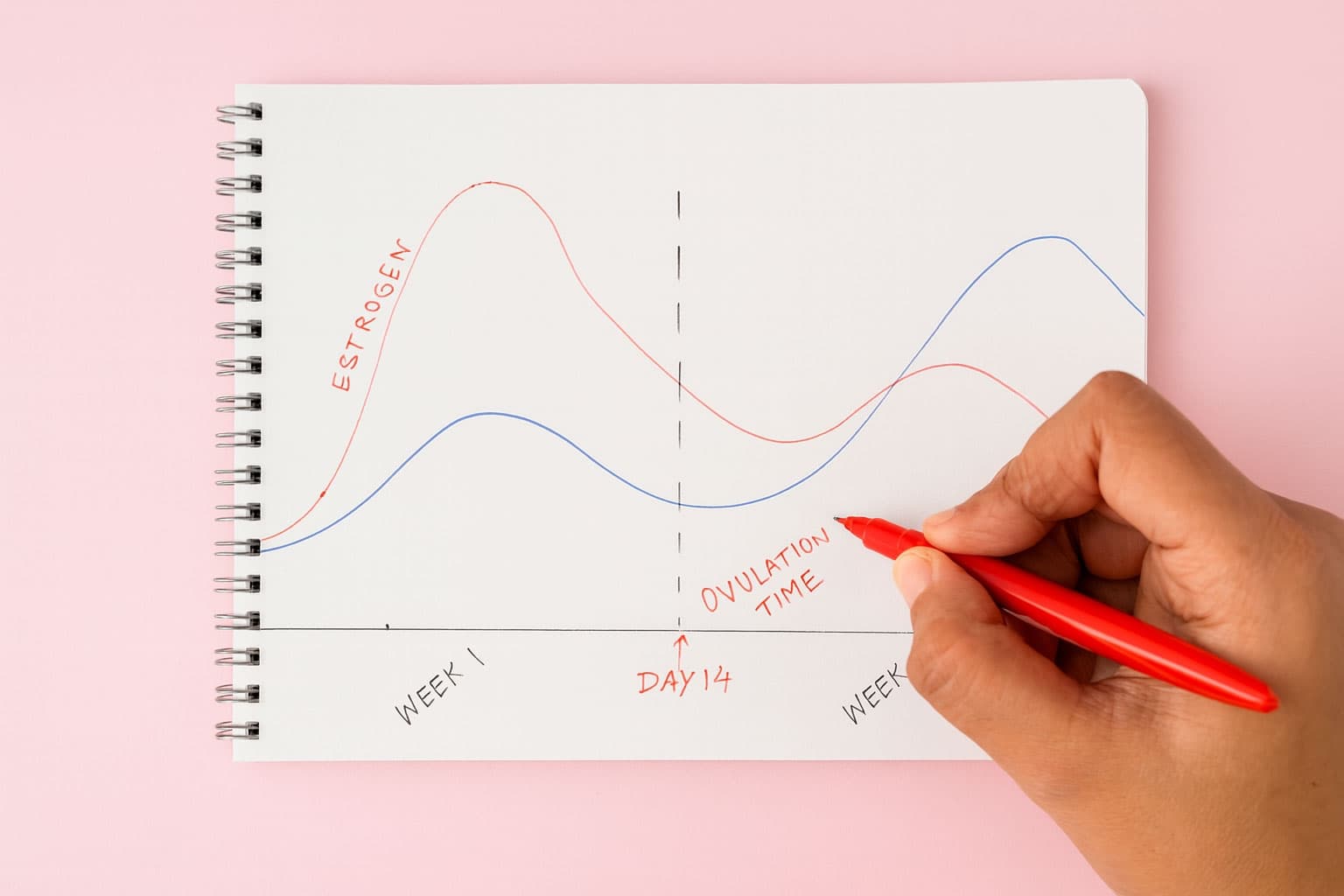
And when that estrogen gets to a peak level, then the brain is going to send out a hormone called LH or luteinizing hormone, allowing that follicle to rupture, the egg to be released and ovulate. And then that follicle is going to reform and make progesterone. It becomes something called the corpus luteum.
So that first half of the cycle where you're growing the egg is known as the follicular phase. This is the estrogen-dominant phase. You don't have any progesterone. FSH is stimulating that egg to grow and estrogen to be made. That peak estrogen level is telling the brain, hey, we're mature. And then that estrogen is causing the brain to send out an LH surge, ovulation, and then the second half is known as that luteal phase where the corpus luteum is making progesterone.
And now progesterone is being made in pulses because LH is sent out in pulses. So you're having progesterone released throughout the whole luteal phase, but depending on when I check it to when your brain sent out a random LH pulse, that progesterone level could be anywhere from 3 to 40 nanograms per milliliter. So it could really vary, but its presence is the key.
If you get pregnant, that pregnancy comes and it rescues that corpus luteum. You start making hCG. If you don't get pregnant, the corpus luteum can only live for two weeks. So it dies. Progesterone levels drop and you get a period.
Eggs are always leaving the vault
Dr. Natalie Crawford: What's happening at the ovarian level is that all of the eggs who are not chosen to ovulate, they die. So you are losing more eggs than just the one that you're ovulating every month. And this process of eggs coming out of the vault and eggs dying continues really no matter what. Meaning, before you start your period, you're losing eggs. So before you even go through puberty, eggs come out of the vault. There's just no FSH from the brain because that's what puberty is, is the brain turning on and sending out FSH and LH.
When you're pregnant, eggs are still coming out of the vault, but there's no FSH because the hormones of pregnancy are suppressing the brain. So you're just losing eggs during that time. And the same thing when you're on the birth control pill. The hormones in the birth control pill prevent the brain from sending out FSH. So eggs come out of the vault. They just do not ovulate. They do not change, but you are still losing them that entire time.
So just by thinking about what's happening in the course of a menstrual cycle, you can think about how it can be really hard for you to walk into my clinic and draw an estrogen and a progesterone and really be able to interpret that value without the greater picture of where you are in your cycle.
What AMH tells us and what it doesn't
Dr. Natalie Crawford: When it comes to AMH, as we started the discussion, AMH is made from the cells that surround every follicle. So if you have more eggs in the vault, you have more follicles being sent out of the vault. You're going to have a higher AMH level. When you have fewer eggs, fewer are going to come out. You're going to have a lower AMH level. So if you simplify it, AMH is a marker of how many eggs are outside the vault right now in this month.
Importantly, nobody's body is perfect. So that number is going to fluctuate every month. If I say somebody's age, they should have 20 eggs, they might have 20 then 17 then 18 then 16 then 22. And checking an AMH in every single month will fluctuate some. So we have to understand that if you have a value checked and a year later you get another value and it's lower, you don't need to calculate the slope of the line and tell me when it's going to be zero and presume you're going to be into menopause because really there's these fluctuations every single month. But we know over time this does drop. Low values for your age does correlate with going into menopause early.
Having low values can make fertility treatments harder because when I do IVF, I am only getting the eggs outside the vault to grow. I can't tap into that vault. So if you have more eggs available, I'm going to have a higher chance of success. If you have fewer eggs, it's going to make the process harder. You might need more cycles or rounds getting months and months and months of eggs in order to get the outcome that you want.
The debate over AMH screening
Dr. Natalie Crawford: There is a lot of debate over AMH. So there's a reason why I'm starting with it. AMH has been shown in some studies to not correlate with what we call fecundability or your chance of pregnancy per month. And if we think about it in a really simple way, if two women are the same age and one has five eggs outside the vault, so she's a low AMH, the other woman has 20 eggs outside the vault, she's a normal one. If they're ovulating regularly, they each have one egg that's ovulating. So if they're the same age, they have the same odds of getting pregnant.
However, my favorite question is, "But why? Why do you have a low AMH?" And there are factors that can cause your low AMH that absolutely can impact your chance of pregnancy. So I think it's a gross oversimplification to say, well, low AMH doesn't impact your fertility. It doesn't mean that you can't get pregnant. It definitely impacts your reproductive timeline, but to me, it is your body waving a red flag, a warning sign that something is going on.
You shouldn't be running out of eggs early. So have you had chemotherapy? Have you been exposed to chronic inflammation? Do you have an autoimmune disease? Is there something genetic? That one lab test, which is just a simple blood draw, can start us out on a journey to investigate what could be causing that, which could impact your health, but also your plans. You might say, "Gosh, I need to be more aggressive with my fertility treatments because I don't have as much time as I thought I had." And that's just from AMH blood testing.
The debate in the field is over screening women. So young women who are not trying to get pregnant. Is there a utility in checking AMH? And I'm a strong advocate that there is because you can't make decisions on data you don't know. And nobody should be presuming you would do this or that with that information. You are the one who should be able to choose that.
The argument is really based on, well, it might cause undue stress or you might do fertility treatments that you might not ultimately need if you check an AMH and find out it's low before you're ready to conceive. I've been on the other side of the table too much where women were going into ovarian failure, never got that opportunity to know that their egg count was dropping, that their AMH was low, they didn't get the chance to make a choice when they still had time to do so. So I'm a believer that if you want to get your egg count checked, your ovarian reserve, AMH is a great hormone that's providing you some basic information.
It's not everything. Meaning, there are some things that can suppress AMH. It is made from a cell that comes from the ovaries. So if you're not ovulating for a prolonged period of time, whether it's from breastfeeding, pregnancy, birth control pills, hypothalamic amenorrhea, variety of different things, your AMH might be suppressed. So there's different circumstances where we talk through what that might be or how we repeat it, but that still doesn't mean that there's not utility in checking it.
What hormones to check and when
Dr. Natalie Crawford: So what hormones do I check in everybody? I think AMH is going to be the starting gate because in a fertility practice, I think that piece of information is really helpful. A lot of our other hormones really are going to come off and depend on your circumstance. If we're having regular cycles, if we are not, if you're having extra acne or symptoms of androgens, everything there is going to lead into a slightly different hormone panel or an investigation tool.
Mike Haney: Okay. So much there to unpack. No, it's great. I think that it's really helpful actually to our earlier discussion to understand the physiology of what's happening and the role these different hormones are playing. And what I'm hearing in the AMH discussion there is what I suspect is true of a lot of these which is a single number in isolation doesn't actually tell us that much. It's a piece of information and it is valuable but it cannot be interpreted on its own. So it sounds like even when you get an AMH value back that's---I think you said that's the start of a journey---that's okay this is telling us something. It's maybe pointing us where to go.
The airplane analogy: Understanding hormone communication
Mike Haney: And so maybe as a way to talk more about the relationship between these hormones, you have a great analogy of the sort of hormones as an airplane and as an aviation system. So maybe that's a little higher level than what we just talked about in terms of the actual physiology, but maybe if you want to share that analogy.
Dr. Natalie Crawford: I like a lot of analogies. So we're going to go through a bunch of them, but one that I think really just shows the interplay between different organs and our environment and our body is to really think about reproduction, our hormone system as the airport and the airplane.
So if we think about having an airport control center that is your brain, that's the hypothalamus in your brain that is going to send out commands and controls. They're interpreting information that's being sent to it and then they're sending out signals from it. So the hypothalamus and the pituitary gland are in the brain and they send out like FSH and LH like we just talked about.
If we think about the ovary being the airplane, you've got the airplane, you've got, on the plane, you have different hormones that are going to be made and signals that will be sent back. To me, hormones are a communication system. So it's like messaging over the intercom or sending a text message. So from the plane, the plane is sending out its own signals, which are going to be estrogen and progesterone predominantly.
And the runway is the uterus. So that is a crucial piece if you're thinking about your hormones. And what's so funny is that for most women, it's really the only piece of this whole process that we're acutely aware of because we're aware when we have our period when we bleed. We don't really think or are very aware of all the other pieces of the puzzle that are going into that plane taking off and landing.
And then the environment of your body is the weather. And I use this analogy a lot with patients to say this is a fine balance between airport control tower talking to the plane and the plane has to be able to send hormones back. If the runway is damaged, that's going to be difficult. If the plane has mechanical issues, it can't hear what the control tower is sending it. That's going to cause problems with ovulation.
But also in a bigger picture, if it's hailing or it's snowing, there's terrible weather. And we can think about that as chronic inflammation. So inflammation is something that I know we both talk about a lot, is something that can be a normal process of your body that in today's modern world is often a bad thing. Too much of a good thing becomes bad. So acute inflammation is our body's healing response. We cut our hand that comes in that helps us heal.
Chronic inflammation is when these inflammatory markers never go away. It's not just a one-time insult, but it's chronic exposure that puts our body in this overstressed response that we know can cause a variety of hormone issues. And so thinking of it like if you're hailing, even if all the other pieces of the puzzle are going to work, the plane's not going to take off, the plane's not going to land, it's going to be delayed, you're going to have problems, and the destruction can last longer.
Meaning even once that hail clears, you might have damage done to other parts of this process, to the plane or to the runway, that are going to take longer to overcome than just stopping that inciting behavior. So I think really understanding that it's a delicate balance and dance between the brain sending out signals to your ovaries and then your ovaries interpreting and sending signals back.
And so you can have different issues when it comes to irregular cycles, which is definitely one of the top problems that we're seeing. Number one, you have to know what normal is to find abnormal. But then we'll see these different levels of issue, whether it's at the brain and the control tower, whether it's at the ovary and its ability to interpret or send hormones, whether it's at your uterus and you're not bleeding and maybe there's something structurally going on that's causing it.
So trying to get to the root cause of an abnormal menstrual cycle, which is going to be one of the top things that I do, really has to think about all four of these different components: your brain, your ovaries, your environment, and your uterus. And sometimes it's hormonal, but sometimes it's not. So it's not always as simple as let's draw a big hormone panel and see what it shows us. It's really knowing what to look for and when.
Inflammation and other markers beyond hormones
Mike Haney: That's a great lead-in to thinking beyond the hormone panel. So you mentioned inflammation, for instance. Are there particular inflammatory markers that you look at as part of any standard panel or are there markers that you look at if something seems off in that other communication pattern?
Dr. Natalie Crawford: That's a great question. There's been a lot of debate at least in the fertility literature when it comes to trying to look at markers to really give us data on what that means. What we've seen is things like an elevated CRP has been associated with having longer cycle lengths and more irregularity in your cycle, showing us that inflammation definitely is impacting that signaling from the brain in some fashion.
However, I really find that the best marker of inflammation is talking to somebody, going through their body, their symptoms, going through symptoms of chronic inflammation, specifically trying to get them to tease out things that may not have always been present and when did they change.
So when you really sit down and you start saying, have you gained weight or you feel bloated? Do you feel tired? And start running through the whole gamut of symptoms that can be associated with this chronic inflammation. A lot of times, and women specifically kind of gaslight themselves into just thinking this is normal or they've been dismissed so they don't feel like anybody listens to this problem or this symptom when really it is their body trying to tell them that things aren't functioning right.
Mike Haney: Yeah. I heard you say in a video which I really appreciated. If you come in with fatigue I believe you. Like I mean you shouldn't be that tired and if you are there's probably something going on. But how many times do people tell a doctor that they're tired or they have fatigue and it's just completely dismissed or ignored? Versus to me I'm thinking is there an inflammatory process? Is there some autoimmune something going on? Are you exposed to something? There's got to be some reason why you feel that way because your body's not supposed to be that tired.
Other nutritional and metabolic markers
Mike Haney: Are there other things outside of the inflammatory set? Are there other kinds of markers, nutritional markers or other sort of organ function markers that you look at to try to get that initial sense of a whole health picture?
Dr. Natalie Crawford: Definitely. So when we're on our general fertility panel, right? So I said AMH we check already. We also check vitamin D which has tightly correlated as you know with inflammation and nutritional status. Also it's correlated with hormonal health and regulation. And so many people are deficient in vitamin D. I think today's modern world, we sit inside, we don't get exposed from sunlight. A lot of people really need that extra supplementation. So we're always checking that one.
Checking a hemoglobin A1C a lot of times as just a marker of insulin resistance and trying to help patients see that tangible sign. And I have so many patients who are in the slightly insulin resistant range. They're not fully over the line and their PCP says it's no big deal and they're fine. And I'm saying this is the time where you can make a change and it can be really impactful.
And so lab work and blood work, that data can be motivation. It can really help somebody understand how the choices they're making are impacting their body and kind of use that as leverage and as fuel to kind of get to that next step.
When to test: Timing matters for hormone panels
Mike Haney: So I know when it comes to hormones, we've talked about how dynamic they are, particularly within a woman's body, given the cycle. What is the ideal time within a month to test if we're talking about---I imagine this is going to vary. And I want to talk about not just folks who are in the sort of fertility stage of their life, but maybe pre-fertility or meaning not yet trying to conceive or sort of post-menopausal women as well. But just focusing on that first group of folks, what's the best time? Is there a best time of the month or does it matter as long as you know what time of the month we tested?
Dr. Natalie Crawford: There is a best time depending on what you're looking for. So let's talk about standard times of when we check and how that could be helpful for us. So one of the typical times to check hormones is going to be what we call early follicular. So this is day one is considered the first day of your period. That is the start of the follicular phase where your body's going to start to grow that follicle or that egg. So usually cycle days two, three, or four is a baseline time for most women.
Meaning in that frame, you should have a low estrogen. Your FSH should be in the normal range, meaning it's starting to be sent out. And your testosterone should be low as well. Testosterone is also made from the ovaries, but it partners and mirrors estrogen, meaning it will vary based on which phase of your cycle you're in as well. So if you're coming in and we're checking, people just call them day three, but two and four are just as good, or we're checking early follicular values.
And what I'm looking for is that essentially your estrogen and your testosterone are on the low side and that your FSH is in the normal range. Now, one thing that we sometimes can see is you might start to have an elevated estrogen with a normal FSH. This is the first sign that your egg count might be starting to drop and you might see this associated with some period shortening. So some actual change in your cycle, why cycle tracking can be so helpful.
So at this time, you might say, okay, my body is now growing an egg faster. That means I didn't have as many eggs outside the vault because the same signal, the normal FSH, wasn't getting diluted by as many follicles. So it was a stronger signal to one. So it started to grow sooner. So if you are young and I'm checking day three FSH and estrogen and I see this estrogen elevated, I'm suddenly, oh, are we potentially going into a low ovarian reserve stage soon? And this might be one of those first signs that we're seeing.
The stage after this when it comes to ovarian aging that you might see would be a high FSH. So typically at this place your estrogen's still low, but now your FSH is more than 10. Now what we're seeing is that the ovary is starting to get a little more stubborn. It doesn't want to lose some of these eggs. So now it's taking a stronger signal. The brain's having to work harder to get you to ovulate. This is classically associated with perimenopause. And you start to see some period irregularities in this phase where you'll go from really significantly shorter cycles because you're ovulating sooner to then you're going to start to ovulate longer and spacing out as that ovary gets more and more stubborn.
Checking progesterone: Why timing is everything
Dr. Natalie Crawford: So looking at this early stage, progesterone---there's no reason to check progesterone if I know you're day two, three or four of your cycle. People check it all the time in a hormone panel and that's fine. But if your periods are regular, I know there's no progesterone. Progesterone is made after ovulation.
If we are trying to look at progesterone, a classic test is called a mid-luteal progesterone, really coined a day 21 progesterone, which has done it such disservice. The day 21 came from a standard 28 day cycle, which we know less than 20% of women actually have a 28 day cycle. But it's about a week after you ovulate, your progesterone level should be high enough in your blood where it's at least three nanograms when you check a serum level.
And again, as we talked about earlier, that progesterone can fluctuate. A lot of people will see a progesterone level of five and say, "You're not making enough progesterone. You have a bad luteal phase. You need to take extra progesterone." That's a really gross misunderstanding of how we check serum progesterone because it is going to fluctuate over time.
And whether you need supplemental progesterone, that is typically going to be classically more demonstrated by having spotting in the luteal phase or potentially a shortening of your luteal phase, which would tell me knowing your cycle and when you ovulate is number one the most important thing. Lab work and blood work can help supplement that knowledge. And every patient I see in clinic---so I do ultrasounds, we draw labs, I draw all these hormones, I draw them all the time---I will never do any of that without asking where are you in your cycle because where you think you are or where you are, is that what's really happening in your body? And that impacts how I'm interpreting these different labs and this different blood work.
Testing when cycles are irregular or absent
Dr. Natalie Crawford: I will say that if you have irregular cycles or if you have no cycle, well, when do you wait till day two, three or four? Do you induce a fake period to try to get those tests? No. Somebody who's having irregular cycles or who is not having a period at all, that's a very different circumstance.
So that's where we would say if you have amenorrhea or no cycle, we're going to check a more complete hormone panel just randomly. And we are checking your FSH, your estrogen. We're checking your LH. We are looking into some of the androgens. We're looking at prolactin and your thyroid because those are brain hormones that also can impact how your brain is sending out FSH and LH.
So the panel that might happen because you're having no period can happen at any time. When you start thinking over on, well, I'm having irregular cycles. Well, does that also correlate with signs potentially of polycystic ovarian syndrome like PCOS, which is where your body has high androgen levels? Then we want to do a deeper dive into some of the androgens that you might have on your blood work to really make sure that this is PCOS or what is going on.
So when I have patients, I always start with give me this good history. We spend the first part of our visit letting the patient tell me what's going on, but then really nitpicking and deep diving into their menstrual cycle and their menstrual history. And so one of the best things I think is you know your body best and you know if it's not normal, but you can help out your doctor by being able to explain this information about what's different, how it's changed, what you're concerned about, because I can only go off the information that I'm given.
So if you say, "Well, my period used to be 30 days, and now it's 26, and now I have four days of spotting before I start my cycle, and I'm so tired." And these things all add together to really help us know what all we need to be testing and what could be going on.
Preparing for blood testing: Track your cycles first
Mike Haney: So if you're thinking about going to get a blood panel, either specifically because you're trying to solve a fertility or hormonal issue, or you're just going to go get a big blood panel from somebody, is there utility in thinking about that a couple months early and actually doing, if you're not already, doing some cycle tracking and kind of paying attention to changes that might be happening? How am I feeling? Is there anything new before you go get that panel?
Dr. Natalie Crawford: I definitely think so. If you're trying to get the biggest bang for your buck, really know the most about your body, and you're going to get this big blood panel drawn, I think that it's going to be the most useful if you're doing it in that early follicular phase. Well, you may not be able to just call and go immediately the next day. So kind of thinking about if your cycles are regular, that's going to help you.
Whether you want to be pregnant or you don't, your cycles should be regular and predictable. If you can't look at a calendar and tell me within a couple days of accuracy when your period's coming, it's not normal. And there are subtle---the first stage of ovulatory dysfunction is what we call a luteal phase deficiency. Meaning your follicle wasn't strong enough to make a corpus luteum that could last the whole two weeks. So it's really subtle because your period might still appear regular, but it's going to appear different.
And if we start noticing when we ovulate versus when our period's coming, if that second half is 10 days or shorter, we're really starting to be concerned that this is that first sign of some ovulatory issue that should be investigated. Any period abnormality should always be investigated no matter what. Some of these things can make a huge impact on your life.
And I have seen so many patients who will have such irregular periods but still feel like they need to try for a year before they come see me to get a fertility evaluation. But having an abnormal cycle is a do not pass go. This deserves an evaluation of its own.
So if you're trying to be really healthy and advocate for yourself and you're going to go get a blood panel drawn and you start tracking your cycles for a couple months ahead of time and you notice they're not regular, you really might---you can still get the blood work done, but that really might need you to want to also take that blood work and go share it with your doctor. And they're going to ask first question or they should ask is what cycle day were you when this was drawn? And so being mindful of when you're getting that drawn can be helpful, right?
How birth control affects hormone levels
Mike Haney: How much does any of this change if you're on birth control in terms of what you expect to see?
Dr. Natalie Crawford: You would be so shocked how many patients I will see who get a blood panel done when they're on birth control pills and then they're referred in for abnormal findings that are completely normal in the context of the pill.
So the birth control pill is a type of synthetic estrogen and progesterones. It's ethinyl estradiol is the estrogen. All birth control pills have just different amounts of that estrogen. And then there's a variety of different synthetic progestins that can go in the pills to make them act differently. This ethinyl estradiol does not come up on your blood panel as estrogen. So it's not estradiol.
Meaning if you're taking a birth control pill, I can't check an estrogen level. It's not a reflection of the pill. But because of how the birth control pill works, it tells the brain not to send out FSH because the brain does recognize that ethinyl estradiol. So the brain sees the estrogen from the birth control pill and says, "An egg must be growing. Cool. We don't need to send out any FSH."
So your brain has very low FSH, very low LH, very low estrogen. And that's all extremely normal on the birth control pill.
The other thing that we see on the birth control pill, which can be both good and both bad, is that the birth control pill is metabolized in the liver. So in the liver, there's also a hormone made called sex hormone-binding globulin. And this is a really interesting hormone. I always say your body wants to regulate itself. It wants to have normal levels of hormones. And so the whole point of sex hormone-binding globulin is to go around and bind up some extra hormones so that you have the right amount of the active hormone.
So if we use testosterone for example, in premenopausal women testosterone levels are relatively low and most of your testosterone will be bound up meaning there's a very low amount of what we call free testosterone, the nonbound testosterone. Well if you take the birth control pill that is going to increase production of sex hormone-binding globulin.
So let's say you have an increase in testosterone production and you have acne and that's really something you're struggling with and your dermatologist says you should take the birth control pill. The reason why is because this increase in sex hormone-binding globulin is going to bind more of that testosterone so you have less free or active testosterone in your blood.
Now, in that circumstance, the pill is hugely advantageous. It can help with extra hair growth. It can help with acne. Patients who have hair loss even from androgens---we think about male pattern baldness---women can experience that if they have too many androgens. Sometimes the birth control pill can completely stop that. So it can be very impactful for some of these high androgen symptoms.
On the other end, it can also bind some of your testosterone so you have less testosterone. And so a lot of women or some women complain of having a decreased sex drive when they're on the birth control pill. So nothing is without consequences and side effects and one treatment might be right for one person and not the other person.
But I think it's just highlighting for us that the pill completely changes your hormone parameters. As we just talked about estrogen, FSH, LH, testosterone are all going to be lower and you're going to have your sex hormone-binding globulin if you're checking it elevated if you're on the pill.
Are low AMH results ever anomalous?
Mike Haney: Right. That's super helpful context. We talked about this idea of the vault releasing eggs and how that number goes down over time and that that's one of the things you're looking at through some of these markers is to get a sense of where somebody might be and is that number decreasing early. How linear is that? In other words, what's the chances that you get an anomalous result that you get a result that suggests that the number is lower than it should be, but that's a one-time caused by some other thing, some other condition, some other lifestyle thing.
The sort of larger question I'm getting at here is if I see a result that's off in any of these markers, how likely is it that it's just a sort of one-time anomaly that something has caused versus telling me really something about where I am in that life stage?
Dr. Natalie Crawford: AMH is probably one of the ones that we know does fluctuate, but it does decrease over time and more exponentially the older you get. Meaning the change from 30 to 36 isn't that significant. The change from 37 to 40 is quite significant. So as that acceleration of the decline of eggs really starts, you do see a more profound change.
I'm in town very frequently and I tell all my OB-GYNs, if you want to check somebody's hormones, do it. If their AMH is low, you can send them to me. And I tell every patient who comes in really freaked out and I say, "Hey, most likely this is a real value." That's the most probable scenario. We're going to correlate it with an ultrasound to really try to get context on how severe this may be.
The exceptions there are going to be the birth control pill again. If somebody's been on the birth control pill or an IUD or some type of hormonal contraception that has prevented them from ovulating for a while, because I don't believe you have to come off your pill to check an AMH. And so I'm an advocate for checking it just with the caveat that most of the time it'll be normal. No big deal.
Let's say you are on the birth control pill and it comes back low. Well, then we have a choice. Do we want to stop the pill for two to three months, observe, and then recheck and look with an ultrasound or do we want to make forward action based on this number? And that's going to be different for every single person. But if you're contracepting, that's not an indication to not check these hormones, but all hormonal contraception can impact your AMH.
And then some of those other caveats, all of these hormones---the same things very well, almost the same things that impact with the pill. Breastfeeding is going to do very similar. So with breastfeeding, your body's making a lot of the hormone called prolactin. Prolactin is typically not made outside of the circumstance of breastfeeding. It is sometimes stimulated by nipple stimulation, by exercise, by eating, by time of day, and it can definitely cause the entire spectrum of menstrual abnormalities.
But when you're breastfeeding, as a good example, when your prolactin is high, your pituitary gland is very busy sending out prolactin and it is no longer going to send out FSH and LH. It just cannot. So when you think about the brain, think about the hypothalamus kind of interprets signals and the pituitary gland stores all of these brain hormones and then sends them out. So it's not going to send out FSH or LH. You're going to then have not ovulation. So you're going to have low estrogen and kind of that same spectrum of hormones that looks very similar to when you're on the pill, but just from a different root cause.
So I would also be really skeptical about trying to go get a hormone panel done if you were postpartum, if you're breastfeeding. That's what we call lactational amenorrhea, and that can actually be an effective form of birth control because you're not ovulating if you are exclusively breastfeeding in those first few months.
When and how often to retest
Mike Haney: So it sounds like you can get anomalous results, but they're typically tied to an explainable cause of some kind. I'm breastfeeding. I'm on contraception of some kind. You touched there on another question I want to get at, which is retesting. So I get a panel done, it's either normal or something is abnormal. I suspect if it's normal, I'm not terribly worried about retesting unless some circumstance in my life has changed. If I get a result that's abnormal in any one of these, even if we can kind of unpack the cause, how often do you recommend retesting? Are there things that you would retest right away because that might just be an anomalous result? It might be something that we can't quite pinpoint or is it let's wait a couple of months and test again?
Dr. Natalie Crawford: Great question. Because prolactin can cause the entire spectrum of menstrual abnormalities as we said and it is influenced by weird things like eating and exercise. It's also influenced by where you might be in your cycle. So if somebody gets a random elevated prolactin, I'm always repeating it and we're repeating it fasting in the morning and the follicular phase.
So that is going to give us the lowest value your prolactin should be. So if you want to bypass that retest step when you go get your hormone panel done, another kind of advocate for cycle day two, three or four, you can be fasting, go first thing in the morning and then you know that that's the lowest your prolactin will be. So if it's an elevated value, that's a real value.
Another hormone that fluctuates that we might repeat or retest at a sooner frequency is going to be TSH or thyroid-stimulating hormone. Just like prolactin, the thyroid can impact the entire spectrum of menstrual abnormalities and subclinical hypothyroidism, meaning your brain is working harder to make a normal amount of thyroid hormone.
So when we think about the thyroid gland, that's a nice butterfly-shaped gland in the neck. Thyroid-stimulating hormone comes from the brain, well-named hormone that works to stimulate the thyroid. And then the thyroid hormone makes thyroid hormones. So the thyroid gland makes these thyroid hormones T3 and T4. And then the brain senses how much T3, T4 you have to tell, do you need more or less TSH? And what you need, what I need, what my patients need---everybody needs a different amount of T3 and T4.
So checking a TSH is a nice way to see if your brain senses you have enough thyroid hormone. Well, in---I would say Natalie, in my regular life, my thyroid hormone has a bigger range than if I am Natalie and I'm having menstrual abnormalities, pregnancy loss, or infertility. Meaning, we know that when your TSH is on the higher end of the range, even if your thyroid hormones are normal, that that can have some important reproductive consequences. And so we want to treat that a little bit more aggressively in those life stages or if it's borderline, repeat it in four to six weeks and at least see which direction that it is going in so that we don't risk something that could have been helped with a simple medication.
So very often a lot of these hormones fluctuate so much like FSH and LH and estrogen, we don't always just say, "Oh, this is off. Let's go repeat it." More often than not, some of those reproductive hormones are diving into a bigger investigation of why that might be low.
When it comes to AMH, I will say even though I said most of the time it's a real value, I have had patients that had a very low value and they came in for an ultrasound and it did not correlate and we repeated it and it was fine. And so I have to believe that that was just a lab error. It is a little bit more difficult test than the rest of the hormones with how it's processed. So the blood isn't processed quite the same as all the other steroid hormones. And I think that leaves it a little bit of a higher risk to be an abnormal result than all the other steroid hormones that are out there.
But that's why I always think if you get a low AMH, it's not just okay, well this is low, so what? I said go get an evaluation done. So that's the time to go schedule an appointment with a fertility doctor. Let us do an ultrasound. Let us look to see if this is a real value and what may be causing it. Things like endometriosis, like we said, autoimmune disease, those things can impact your AMH and your entire life. So whether you want to have kids or not, that could still be very impactful.
On the other hand, I do want to make sure I say that a normal AMH doesn't mean you're fertile. It doesn't mean you can get pregnant. It's just telling us that you are in a normal stage of ovarian aging at that time. It doesn't tell us anything about the quality of the eggs. Quality or the genetic normalcy of your eggs is tied to your age. So if you are older, if you're 42 and you have a really high AMH for your age, that doesn't mean you have the ovaries of a 30-year-old. You still are going to have issues because of how long the eggs have been inside your body and the cumulative wear and tear that they've absorbed just from living your life and what that's going to do to the chromosome complement of your eggs.
How lifestyle impacts hormones and fertility
Mike Haney: So maybe one place to tie this back to where we started. I think it's possible to listen to this discussion and the explanation of the physiology and think most of these values are mechanistic. They are tied to things like age or whether I'm lactating or whether I'm on birth control. But you know, we started talking about lifestyle and exercise, nutrition, those kinds of things. So maybe as a way to kind of wrap this up, let's talk about how lifestyle can impact these hormones, how movable they are. And we could talk about them individually, but how movable they are by lifestyle, and just what that relationship is. Tell me why this isn't just sort of purely mechanistic that my body is at the stage it is, therefore my hormones are this.
Dr. Natalie Crawford: I love it. I love talking about lifestyle because it really is one of the things you can control. You can't control your age. So if you are starting your family at a later age, you are starting your family at a later age. But you can control a lot more than you think about.
So when we think about lifestyle, we think about inflammation. That can mean a lot of different things. But let's go through, as you said, kind of a few different hormones. So one thing that I always think is really fascinating to circle things back is when we think about your gut and your gut health and how that impacts estrogen metabolism specifically.
Gut health and estrogen metabolism
Dr. Natalie Crawford: So inside your gut, your cells are all lined up in this perfect little lining, and they act like a filter for your intestines. And when your gut is exposed to inflammation, specifically chronic or inflammation that doesn't go away, these cells start to get spaces between them and it increases the permeability of your intestine. This is sometimes called a leaky gut, if you've seen that. So a leaky gut means that your intestines are no longer doing their job of keeping things that should be excreted from your body inside your intestines and what should be exposed to your bloodstream.
Now your gut also has its own microbiome and so the microbiome of the gut is influenced by when there's inflammation, when you have this leaky gut, that is going to shift the bacteria inside your gut to be more abnormal than normal. The other thing that kind of plays a role with both of these factors is fiber. So diets low in fiber have more inflammation, worse leaky gut, and they worsen that ratio of the bad and the good gut bacteria.
Well, inside your gut, those microbiome, it makes an enzyme called beta-glucuronidase that is important in the estrogen metabolism process. So your body makes estrogen. Where does it go? It gets metabolized in your liver and then it gets excreted in your urine, bile and in your stool.
So when you have an abnormal shift of this enzyme, you're also going to see an abnormal shift of your estrogen metabolism. And if you're not getting rid of estrogen that you should be, that is going to interfere with the brain interpreting you have a low estrogen. So if we think about the fact that this corpus luteum dies, estrogen and progesterone levels drop, well I need them to get out of your bloodstream for your brain to be able to see that.
But if that process is being delayed because of the inflammation inside your intestine, the brain doesn't see that drop in estrogen as quickly as it should. And that means it's going to take it a while to come in and send out more FSH to realize that estrogen has really dropped. So that's a very tangible explanation of how things that you eat, so specifically processed foods, artificial sugars, foods low in fiber, directly are impacting the estrogen metabolism inside your body and therefore your brain's responsiveness to how it's going to send out FSH and LH.
Inflammation from stress, sleep, and exercise
Dr. Natalie Crawford: Chronic inflammation in general, and sometimes it's from the food we eat, sometimes it's from stress, not getting sleep. Sleep is when your body heals a lot of your cells and if you don't have as long to heal, you're not going to recover from some of this inflammatory process as well. We also can see chronic inflammation from high-intensity exercise all the time. More than half of runners have menstrual cycle abnormalities or luteal phase defects. And it's not because they're eating poorly. It's truly because of some of that inflammation, because of the constant breakdown in your body.
So when we look at all these things, there's some things you can control, but there's also chronic inflammation from disease states, from insulin resistance, from PCOS, from endometriosis, autoimmune disease, and some of that you can't always control. So I'll have patients when I say, "Hey, you might not be able to control all of it, but we certainly shouldn't be adding to it. There's no reason for us to be making choices that are making that inflammatory burden even worse."
And just like that analogy when it came to our airport, that high inflammation, that bad weather makes it really hard for the brain and the ovary to communicate properly. And we see hypothalamic dysfunction, menstrual cycle changes, but we also see lower fertility rates in inflammatory diseases. So there's definitely a correlation with having high inflammatory states and seeing hormone change and having that impact directly your fertility as well.
"You might not be able to control all of it, but we certainly shouldn't be adding to it. There's no reason for us to be making choices that are making that inflammatory burden even worse."
Practical lifestyle recommendations
Dr. Natalie Crawford: So I think it's not true at all that you don't have control over some of these factors. And the things that I recommend. So I say number one is sleep. So make sure that you're getting seven and a half to eight hours of sleep at night. This is a---if you have a partner, it includes them too because if they're watching White Lotus up at night, you're not sleeping. So you need a dark room. You need to put your phone somewhere further away so it's not right by you. You really have to make a good sleep environment. I'm a big fan of like sleep masks, sound machines, and really just making sure that you truly can get as much rest as you need.
When it comes to stress, everybody's really different when it comes to stress, and there's a lot of different ways we can reduce stress. But taking 20 minutes, whether it is putting your feet in the grass outside, going for a walk, meditating, journaling, mindfulness, yoga, acupuncture, taking that moment away from your screen, without your cell phone right there. It really does play a role in dropping cortisol, which is the stress hormone. And cortisol is an inflammatory hormone. So that alone if you have high stress levels is directly impacting your levels of inflammation.
And then from there using exercise as a tool to build muscle. Your muscle directly can help fight insulin resistance and can help balance your hormones for lack of a better word. So leaning away from the high-intensity interval training and more into more moderate activity and strength training is better for your hormone health.
And then looking at avoiding toxins where you can when it comes to BPA, plastics, kind of looking at fragrances and things in your environment that we know can be hormone disruptors.
And then food. Really, a diet should be primarily whole food plant-based. That doesn't mean you can't have other things, but fruits and vegetables, the bulk of what you're eating, they're high fiber. They are not inflammatory. They fight inflammation. And then kind of bringing in and making sure the other foods are not processed foods that they're not added sugars.
I tell every patient, you know, we know what's bad for us. Like we know that the fried food or the takeout food, we know the things that we're doing because we know how our body feels after we eat those foods. So if you really learn to listen to your body, track your cycles, pay attention to the clues that your body is giving you, you can start to make these changes, and every change counts.
This is not an all or nothing world. I think so often when it comes to lifestyle changes, somebody sits on the other end of a conversation and feels like, well, I'm not going to do all those things, so there's no point. But I always say it's like a meter. Every single little change that you can make is impactful for your health and is a win. So really think about where can you make those differences and start to prioritize your own health.
Mike Haney: I think that's great context. It's why I love blood markers. Actually, I've come to really appreciate that source of data because there is an incrementality to it. I can see my A1C, my A1C is still high. If I see it go down a little bit, it's motivation. I get a little bit of reward for the things I've done.
Lifestyle changes show up in the lab
Mike Haney: So what I'm hearing you say in the context of life cycle is um it really can affect how that airport runs. I like the weather analogy and that that can have sort of durable effects. So I assume you see in your patients this kind of effect when you start working with them on that functional basis. Do you see those changes of somebody getting healthier and that then improving their fertility?
Dr. Natalie Crawford: The most finite way of measuring this is early in this conversation I said even with IVF that lifestyle can play a big role. And this is both egg health and sperm health. And when you look at how eggs and how sperm act in a lab, you get a lot of data. And so sometimes you will go through a cycle and you will have results that really are below average and you can pinpoint well this is when the sperm genome kicked in and you go and you talk and you realize well you know we're smoking marijuana every day and we didn't endorse that or this or this behavior. And it's not blaming but it's really lack of knowledge.
And then making those changes and doing the same cycle again and seeing that difference in how the eggs and the sperm function together in the lab. I mean, that's hugely impactful. So we really are able to know that these little changes that I actually think are big changes. They're huge for your whole body, your health, your hormones, your longevity. They really can make an impact directly on to your own body's health, onto your sperm and your eggs and how these things function.
So I always talk about lifestyle and give my patients kind of a like 101. This is what you should do. And then for certain conditions once we get into that root cause analysis and we might have this or that, we might fine-tune it based on disease state. But I think too often we dismiss that and we lean on traditional medicine, especially in a high-tech world like fertility. When honestly, I think it should be the opposite. That should always be our first line of defense or at a minimum incorporated with technology so we can get the best outcome possible.

Get your hormones tested with Levels
Levels pairs real-time glucose data and comprehensive lab testing with clinician analysis and personalized support—everything you need to turn insights into real health improvements. Click here to get started with Levels.