What you can learn from a DEXA scan
A DEXA scan is the gold standard for understanding your bone health and body composition. Here’s how to read your results.


When people want to get healthier, they usually step on the scale ... and then focus on losing weight. But weight---or BMI, determined from height and weight---isn't enough to tell if you're metabolically healthy.
Body mass index (BMI) is a measurement that expresses your body composition as a ratio of your height and weight. When that ratio is high, it has value: for tracking trends in weight on a population level, and in sounding the alarm for chronic disease risk on an individual level.
Get more deep-dives like this delivered to your inbox
Sign up to make sure you see our latest articles, as well as recipes and discounts
But using BMI as a standalone metric of health is flawed: While it classifies people as "obese," BMI isn't very good at determining where someone carries excess body fat, let alone if they have excess body fat, because it can't tell the difference between muscle and fat---an essential distinction for health.
To get a true glimpse at your metabolic health, you want to measure not just your weight but your body composition---the amount of fat, bone, and lean muscle. The gold standard for measuring this is a dual X-ray absorptiometry (DEXA) scan.
This low-dose X-ray scan takes about 10 to 20 minutes and is available at clinics across the U.S. It's used clinically to diagnose osteoporosis, but DEXA is also the "gold standard" test for accurate measurement of body fat and lean mass. A DEXA scan also provides important information about that fat---where it's located on your body and an estimate of how much is visceral fat, a more dangerous type of adipose tissue associated with medical conditions like insulin resistance and cardiovascular disease. That said, DEXA isn't perfect: It can't measure the most dangerous fat---intra-organ fat, such as liver or pancreatic fat---which requires imaging techniques like MRI or CT for direct measurement.
But DEXA is still one of the most comprehensive scans for metabolic health, says Dominic D'Agostino, PhD, associate professor of molecular pharmacology and physiology at the University of South Florida Morsani College of Medicine. He believes knowing your body composition changes over time is more informative than many other more common biomarkers, like LDL cholesterol or triglycerides.
Here's everything you need to know about a DEXA scan, how to get one, and how to use its data to improve your metabolic health.
What is a DEXA scan?
DEXA (sometimes abbreviated as DXA in medical contexts) is short for dual-energy x-ray absorptiometry. The "dual" part refers to the two types of X-rays used. These two energy levels let the scan determine the various densities of different body tissues so it can distinguish what's bone, what's muscle, and what's fat.
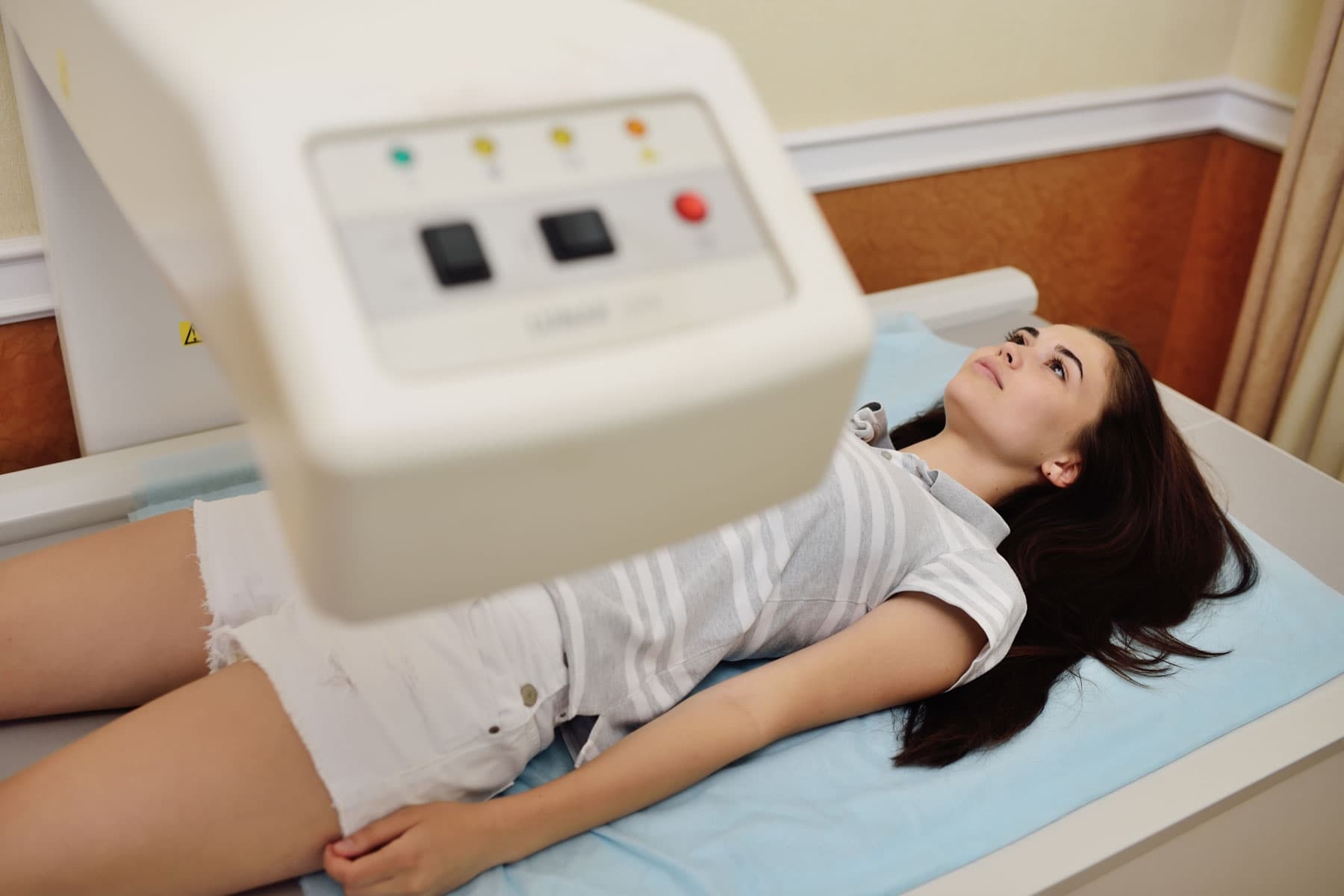
During a DEXA scan, you're asked to lie down on a table. A C-shaped arm will scan over your body on the table. The scan takes 10 to 20 minutes.
The most common use for DEXA scans has been assessing bone density, a measurement of how much calcium and other minerals make up your bones. When your bones are more densely packed with minerals, they're less likely to break. When density is very low, a person has osteoporosis. In this dangerous condition, bones are more likely to break from "low-level trauma," like falling from a standing position. One in three females and one in five males over 50 will suffer a bone break due to osteoporosis at some point.
DEXA scans have been used to determine this density since 1988. Doctors might prescribe DEXA scans to people with (or at risk for) osteoporosis and those with other conditions that might put them at risk for low bone density, like hyperthyroidism.
The DEXA scans produce two scores for bone density:
- A T-score indicates the number of standard deviations between the bone density of the scanned individual and the bone density of a healthy young adult of the same sex.
- A Z-score indicates the number of standard deviations between the patient's bone density and the mean of other people their age. (More on both of these below.)
But DEXA scans are also useful---and accurate---for determining how much of the rest of your body is composed of muscle and fat.
What can a DEXA scan tell you?
DEXA scans provide pages of data points that relate to your overall and metabolic health, helping you understand how much of your body is bone and fat, the health of your bones, what kinds of fat you're carrying, and how much of the rest of your body is made up of muscle. If you get multiple DEXA scans at the same location, as our experts suggest, the report can also show you how all these numbers change over time---and if they're moving in the right or wrong direction.
Here are many of the data points a DEXA scan provides, why they matter for your health, and the healthy ranges for each (where applicable).
Bone mineral content
Your bones are made of minerals, including calcium and phosphate, arranged in a crystal structure; in short, your bones are made of these bone minerals and the space between the pieces of crystalline structure. Bone mineral content expresses how much bone mineral you have. It's your bones' mass, typically expressed in grams.
The report will also tell you where your bone mass is located and how much is in each area of the body. That is, how much of your body's total bone weight is in your head, right leg, left arm, pelvis, etc. Your bone mineral content is used to calculate your bone mineral density.
Bone mineral density T- and Z-scores
These two scores take your bone density---the amount of bone mineral content you have divided by the total area of bone in that region---and compare it to other average bone densities.
The T-score compares your bone density to the average bone density of a healthy 25- to 30-year-old of the same sex and ethnicity---that is, someone who would be at the peak of bone health. The score represents the number of standard deviations you are away from this average. So if your T-score is zero, there's no deviation, and you've got the bones of a healthy young adult. Even up to -1 indicates healthy bone density.
However, a score between -1 and -2.5 indicates osteopenia, a loss of bone mineral density less severe than osteoporosis. And a score below -2.5 indicates a diagnosis of osteoporosis.
While the T-score compares your bone density to a young, healthy standard, the Z-score compares your bone density to the mean for healthy people of your age (as well as sex and ethnicity). This age-matched score is helpful when a doctor suggests "secondary osteoporosis," when bone loss isn't caused by common contributors to osteoporosis like aging or menopause. Risk factors for this type of bone loss include hyperthyroidism, diabetes, certain medications, and other conditions.
Just like the T-score, the Z-score represents the number of standard deviations between your bone density and this average based on your age, sex, and ethnicity. A Z-score of -2 or below indicates low bone mineral density.
Lean body mass and appendicular lean mass index (ALMI)
Your lean body mass reading is everything that isn't bone or fat. This includes your muscles, organs, fluids, bones, and soft tissue. The DEXA scan will tell you how much lean mass you have and, as with bone, where it's located on your body.
Your total lean body mass can give you an idea of how much skeletal muscle you have, but a DEXA scan can't tell you exactly how much you have. Instead, your DEXA results estimate how much muscle you've got by looking at where lean tissue is on your body.
Your appendicular lean mass (ALM) measures the lean mass in your arms and legs. This measure excludes your torso, where all the non-muscle stuff, like organs and liquids, gets wrapped up with the muscle mass. The idea is that if you've got more mass in your arms and legs, you've got more muscle. And more muscle mass is better for your metabolic and cardiac health, as well as overall longevity.
The ALM is turned into an index (ALMI) for how much muscle you have by dividing your ALM (in kilograms) by your height (in meters squared). If your ALMI is less than 5.5 kg/m2 for women or less than 7 kg/m2 for men, you're considered to have low lean mass (or low muscle mass).
Fat mass and fat mass index (FMI)
Your DEXA scan will also indicate how much of your total body mass is fat, expressed in grams, kilograms, or pounds. As with bones and lean mass, the scan will tell you where this fat is on your body.
By dividing your fat mass by your height, the scan also determines your score on the fat mass index, or FMI. This is like a pumped-up version of BMI: FMI is considered to be better for assessing whether someone is overweight or has obesity.
FMI is expressed as kg/m2. For men, an FMI of 3 to 6 is considered normal; over 9 puts a man's FMI into obesity. Women are at a "normal" FMI from 5 to 9 kg/m2; obesity starts at 13.1.
Body fat percentage
This is the percentage of your total body mass that's fat, and it may be the most powerful data point the DEXA scan provides. A higher body fat percentage is a clinical risk factor for diabetes, insulin resistance, certain cancers, cardiovascular disease, and early death. DEXA scans are very accurate on this metric, measuring with a 1 to 2 percent margin of error.
The healthy range for body fat is pretty broad---for men, it's about 6 to 25 percent; for women, it's about 20 to 35 percent. But the type of body fat that makes up that percentage matters; fortunately DEXA results help break this out.
Visceral adipose tissue (VAT) area and mass
This measurement drills deeper on your body fat, delineating between two types of fat: subcutaneous fat, which is soft and stored near the skin, and harder, deeper visceral fat. Body fat made of subcutaneous fat is considered relatively benign. The visceral adipose tissue (VAT) is regarded as more dangerous to long-term health. Higher levels of this type of fat, which usually builds up in the abdomen, are associated with an increased risk of metabolic issues, including insulin resistance, Type 2 diabetes, high triglycerides, and high levels of inflammation. It's also associated with Alzheimer's and certain types of cancer.
A DEXA scan will tell you how much VAT you have in mass, as well as its area. When that area is greater than 100 cm2, you're considered to be at a high cardiovascular risk. At 160+ cm2, the risk is considered "very high."
The ratio of fat types matters too: When the ratio of VAT to SAT is equal to or more than 0.4, the risks of glucose metabolism disorders increase.
One caveat: While DEXA scans accurately tell you your body fat percentage, they're less precise on VAT, especially for people with a lower BMI. In a study where scientists had subjects undergo three consecutive DEXA scans, the percentage of VAT for people with a healthy BMI could vary by 7.1 percent. The scans for overweight and obese participants didn't differ as much, varying by just 6.4 percent and 4.7 percent, respectively. For underweight participants, the scans could vary by as much as 15.2%.
Android/gynoid (trunk/peripheral fat) percentages and ratio
You may have heard of body types described as "apple" shaped, with a larger abdomen, or "pear" shaped, where fat concentrates around the hips and thighs. These fruit shapes aren't just about appearance: They indicate whether a person has more "android" or "gynoid" fat. The percentages of where your fat's located---and the ratio of android to gynoid fat---are another way of looking at the "dangerous" versus "less-dangerous" types of fat.
Android fat, also called central or truncal fat, is concentrated in the upper body, especially around the abdomen. It creates the "apple" shape. The problem with android fat is visceral fat is predominant in this type of fat storage. So, more android fat means more visceral fat.
Gynoid fat, which gathers around the hips and thighs, creates a "pear" shape. This type of fat is associated with more subcutaneous fat tissue, so it's considered a less dangerous type of adiposity.
DEXA reports provide a percentage of your total fat that is android and gynoid. The ratio between these numbers is vital for disease risk. When the ratio of android to gynoid fat is greater than one, studies have shown an increased risk of cardiovascular disease, insulin resistance, Type 2 diabetes, dyslipidemia, and metabolic syndrome.
What can't a DEXA scan tell you?
Even with all this valuable information, DEXA scans can't tell you everything. Your results won't illuminate the following.
1. Exact risk of fracture (or other diseases)
Though DEXA scans provide lots of data that points to risks of cardiovascular disease, diabetes, and fracture, they can't pinpoint exact risks. A DEXA can't say that you're going to suffer a future fracture or that you'll definitely get diabetes or have a heart attack.
Your healthcare provider may want to perform other screens based on your DEXA results to define your risks further. For example, when a DEXA scan shows a T score between -1 and -2.5 in certain parts of the body, doctors may use the Fracture Risk Assessment tool (FRAX) to calculate fracture risk.
2. Why bone density is low
DEXA can show that bone density is low or has diminished. But it can't determine if calcium disorders, parathyroid hormone issues, hormone imbalances, or another reason cause this issue. You'll need more medical tests, like hormone panels, to find the primary and secondary causes of low density.
3. The precise amount of visceral fat you have
While DEXA scans provide visceral fat numbers, this part of the scan isn't as precise as the overall body fat percentage provided in the results. This is especially true for people with a "low" BMI---basically, the slimmer you are, the less precise the scan is at measuring visceral fat.
4. The precise amount of your lean mass that is muscle
The scan determines what's bone, what's fat, and what's neither. But muscle and organs both fall under "lean body mass." Although more lean body mass is considered better, the scan doesn't give an exact amount of muscle.
Lean body mass can also be thrown off by how hydrated your muscles are. For this reason, Mike Nelson, PhD, adjunct professor at the Carrick Institute and founder of Extreme Human Performance, suggests making repeated DEXA scans as similar as possible. Have the scans done at the same location and time of day and with the same workout and meal conditions. So, if you worked out the night before your last DEXA scan and had the scan done without eating breakfast, do that again.
5. Your progress
While there are healthy ranges for body fat and certain amounts of bone density are associated with osteoporosis, the most significant value of a DEXA scan is being able to track your numbers---and progress---over time. A single scan can't tell you how your metabolic and bone health numbers have changed. Nelson suggests his clients undergo a scan two to four times per year.
He says the first scan "is a good starting point, but what you're interested in is relative change. So if your first scan says you're at 22 percent [body fat], and the next is 18 percent, then you're headed in the right direction."
Who should have a DEXA scan?
The National Osteoporosis Foundation suggests that all women over 65 and all men 70 and older have their bone density scanned. For these patients, a DEXA bone density scan is usually covered by insurance. Medicare also covers DEXA scans every two years for women who are estrogen-deficient and at risk for osteoporosis, people taking steroid-type medications, or who have hyperparathyroidism. Most insurance companies don't cover DEXA scans for obesity, but some do.
Even if you're not covered---and not classified as obese---both Nelson and D'Agostino say that getting a whole-body DEXA scan is helpful for anyone who cares about their metabolic health. Without insurance, the price of scans can vary, but clinics in major cities offer scans for about $150 or less, although some can be more expensive.
Are there any risks from getting a DEXA scan?
A DEXA scan involves similar radiation exposure as a standard X-ray procedure, so the risk from this scan is low, according to the Centers for Disease Control and Prevention. However, pregnant people should not get a DEXA scan.
What to do about your DEXA results
If the results of your DEXA scan show that your bone density is low, your body fat or visceral fat is high, or both, there's good news: The lifestyle changes and strategies that improve one of these three numbers improves the others, too. Here's what to do.
1. Exercise, including strength training
Any type of exercise helps with visceral fat reduction in people with overweight and obesity, and some also reduce visceral fat in people with a healthy weight. Research has been conducted on steady-state cardio (like jogging), high-intensity interval cardio, and weight lifting, and all of them help reduce visceral fat in people with obesity. Some work slightly better than others, but choosing an exercise modality you enjoy and will perform consistently is essential.
To reduce fat and increase bone density, make sure that some exercise focuses on resistance training---lifting weights, using bands, or performing strength-building calisthenics. In both healthy adults and people with obesity, resistance training reduces fat and increases lean body mass. And a study of 101 postmenopausal women with low bone mass found that high-intensity resistance training increases bone density by up to about 3 percent. To put that in context, post-menopausal women lose an average of 1.9 percent of their bone density each year. Strength training can flip that loss by about 5 percent.
2. Eat more protein
While bone density diet advice usually focuses on calcium and vitamin D, protein also strengthens bones: A 2022 study of 1,570 older adults found that higher protein intakes (especially animal protein) were associated with higher bone densities.
Low-protein diets are a risk factor for sarcopenia, or loss of muscle mass and function, usually due to age. Protein, famously, is the building block of muscle, so eating it can increase the amount of lean body mass you have. It also reduces fat: One small study found that increasing protein intake can reduce body fat even if you don't lose weight or alter your activity levels.
Research suggests that active adults need 1.2 to 2 grams of protein per kilogram of body weight per day to preserve muscle mass. For a 150-pound person (68 kg), that's 81.6 to 136 grams per day. To increase muscle mass by creating a protein surplus, research suggests 1.6 to 2.2 grams of protein per kilogram of body weight per day; for the same 150-pound person, that's 109 to 150 grams per day.
3. Eat more whole foods and healthy fats and less ultra-processed food
Ultra-processed foods are associated with increased body fat and android fat (the trunk-based fat associated with higher risk of disease). In a study of almost 10,000 people, scientists found that those who ate the highest percentage of their daily calories from ultra-processed foods---like sodas, refined grains, and foods with refined sugars---had higher levels of total body fat and android fat than people who ate less.
Eating more whole foods and fewer ultra-processed foods and red meats is also associated with bone health. This diet has been linked with reduced risks of low bone density and lower risk of fracture.
When it comes to body fat, healthy fats help, too. A diet rich in polyunsaturated fats---like those found in fatty fish, nuts, seeds, and plant-based oils---and monounsaturated fats---like plant-based oils, nuts, and seeds---has been found to reduce visceral fat. In a one-year study of more than 500 older people, half of the participants were assigned to eat a diet where 10 to 15 percent of their calories were from polyunsaturated fats (PUFAs) and 15 to 20 percent from monounsaturated fats, less than 10 percent from saturated fats, and at least 30 grams of fiber per day; the other group wasn't given typical nutrition advice. The PUFA-rich diet didn't create a calorie deficit, so it was not designed to help the experimental group lose weight. But after eating this diet for a year, the PUFA eaters lost an average of 0.84 inches from their waists---0.16 inches more than the control group lost---and they lost a significant amount of visceral fat, whereas the control group lost none.
4. Sleep seven to nine hours per night
Sleep deprivation impacts your metabolic health, including an uptick in diabetes risk, and can lead to unhealthy eating, more body fat, and can even negatively impact bone density.
Too much sleep may also be problematic. In one study of more than 7,700 women, scientists found that sleep deprivation was associated with general obesity---and that sleeping more than nine hours per night was associated with an 18 percent increased odds of visceral fat-focused obesity.
The sweet spot? Seven to nine hours. In the studies listed above, this amount of sleep was associated with better outcomes for body fat, visceral adiposity, and bone density.
5. Get another scan in six months or a year
Nelson and D'Agostino both say a first DEXA scan sets an informative baseline. But the key to seeing how any interventions you choose are working is to get regular scans. Doing so not only helps you see trends in your health but knowing you have a scan coming may encourage you to tighten up for a few weeks, as it does for D'Agostino.
"If I know my scan is coming up, and I'm coming home late from work, I don't skip my workout," he says. "I want to beat [my last DEXA]. It's like a game. And when you gamify it that way, it's a good way to prioritize your body composition."

See how to improve your body composition
Levels helps you see how food and lifestyle affect your health through macro tracking, habit-building, and customized insights and advice. Levels members can also incorporate biomarker data like real-time glucose and metabolic blood testing for an even more personalized experience. Click here to learn more about Levels.