How team member Mike D finally beat dangerous cholesterol levels
Mike DiDonato is one of the fittest people at Levels. But a coronary test scared him into doubling down on lowering cholesterol—and in six weeks, he saw the results.
Within Levels, Mike DiDonato has a reputation. He's the guy who's always on top of his health—nailing the metrics, hitting the gym hard, eating clean. He's been with the company since nearly the beginning, joining shortly after college friend Josh Clemente founded it. If anyone embodied what Levels preaches about metabolic health, it seemed to be Mike.
But for years, he'd been living with a contradiction. His lab results consistently showed high cholesterol—a condition that led to his father's early passing. "My lipids were very high, like in the 90th, 95th percentile," he says. Mike knew his numbers weren't good. He just wasn't ready to confront what they might mean.
"I was sort of avoiding it," Mike admits. "I figured I was generally very healthy—eating well, exercising intensely every day. I didn't have the genetic mutation for familial hypercholesterolemia like my dad did, so I told myself I was probably fine."
But eventually, Josh convinced Mike to go the next step and get a coronary artery calcium (CAC) scan to see what was actually happening in his arteries. The results were a wake-up call.
A fate he'd been running from
Mike was 19 when his father died unexpectedly from a widowmaker heart attack at age 48. "He died with an 8-pack," Mike says—a stark illustration of how cardiovascular disease can be hidden even in someone who appears to be in peak physical condition.
His father had familial hypercholesterolemia, a genetic condition that causes extremely high cholesterol. He was on a statin, and his cholesterol readings were low leading up to his death. But the autopsy revealed 98% blockage in his arteries. "He never smoked a day in his life, never really drank," Mike says. Despite doing many things right, the disease caught up with him.
"After he died, I was told I 'didn't have what he had,'" Mike says. "I didn't have that specific genetic mutation, so I ran from my own health for a long time."
Mike describes the years after his father's death as being on "autopilot"—about eight years of just going through the motions emotionally and physically. The turning point came in his mid-twenties.
"One of the things my dad told me when I was younger is you can't control everything, but at the end of each day, or when you wake up in the morning, if you can look yourself in the mirror and you can be okay with what you're looking at—not necessarily physically, but just what you are as a person—that's all that matters," Mike says. "I remember looking in the mirror and saying, ‘Your dad would be disappointed.’"
That moment sparked a slow rebuild. He started taking control of his health again, building momentum slowly over the years, brick by brick over the next decade. Joining Josh to build Levels was part of that journey, a way to align his career with his personal values. Josh even introduced him to Peter Attia's Drive podcast back in 2018. "The first episode I listened to was about LP(a)," Mike recalls.
But even while working at a company dedicated to metabolic health, even while generally being very fit and health-conscious, Mike knew he had to eventually take that deep dive into cholesterol, especially as his wedding approached. "I promised my now-wife that I would have gotten more imaging done before we got married," he admits. And I did not do that."
The scan that changed everything
A CAC scan uses CT imaging to detect calcium deposits in the coronary arteries, which contribute to hardened plaque buildup over time. It's one of the most predictive tests for future heart attack risk, offering a direct window into what's happening inside your arteries beyond what blood tests alone can show.
When Mike went in for his scan, he was confident. "I convinced myself that the CAC is gonna say zero, I know it," Mike says. "So then what I really need to do is go get a CT angiogram with contrast dye, so that it can see inside your arteries and distinguish hard plaque from soft plaque." The soft plaque, he reasoned, was what he really needed to watch for—the kind that likely killed his father when it ruptured.
Instead, his CAC score came back at 70.
That score indicates early-stage coronary artery disease with calcified plaque already present. Worse, the plaque was in the same artery that had killed his father—the left anterior descending artery.
"I was gutted," Mike says. The results came back on a Friday, right before the company's weekly Friday Forum. "I was so shook. I remember I talked to Josh about it briefly, but I wasn't even in the space for talking about it. I think he could tell."
That evening, Mike tried to hide it from his wife. "She's like, 'What's wrong?' I tried to not tell her—I wanted to wait a day to get my head around it—but she knew something was off," he says. "So I told her I got my CAC back."
"It was just hard to even say the words," Mike says. "Initially, I felt fear. It was like reliving my father's death all over again. Telling my wife was one of the hardest conversations I've ever had. It underscored the risk that our future family might experience what I went through with my dad."
But the fear didn't last long. It quickly transformed into something else Mike is known for: determination. "I immediately said after, 'I want you to know that I'm already in ‘Mike mode’ on this, and I promise you, you are my why, our family is my why, and I will not allow this to continue or to beat me. I'm going to beat it with everything that I have.'"
A new level of intensity
The day Mike got his CAC results, he immediately started making changes. "By that evening, I had already done enough research and talked to enough people to realize the main thing we need to do is flatten the curve," Mike says. "I was already checking out models and trying to figure out resources, including finding a philosophically aligned cardiologist, to help me model out my dad's trajectory versus mine right now."
Mike also felt something else: a sense of responsibility. "I think feeling blessed and fortunate that I had this information and a deep sense of responsibility for those like my dad that did not have this information and could have changed their fate—that I had that opportunity."
Although already eating clean, Mike identified changes he could still make. He nearly eliminated red meat from his diet—something he really enjoyed. He dropped his saturated fat intake to 20 grams or less per day—a dramatic reduction. "For anybody that has never looked at labels for saturated fat, 20 grams is pretty hard," Mike says. Things he loved had to go or be dramatically reduced: butter, whole eggs (he switched to mostly egg whites), whole milk. He shifted heavily to lean proteins like chicken and turkey, added more fatty fish rich in omega-3s, and continued his already high fiber intake of at least 40 grams daily, with a focus on soluble fiber, including psyllium husk.
"I have to be honest, I'm like six or eight weeks in, and I still eat lots of delicious food," Mike says. "I was a little bit doom and gloom at first, like, 'Is the diet gonna really suffer? Am I gonna hate it?' But I'm lucky that my wife is supportive and comes along on these escapades with me."
"I'm using the Levels Heart Health program to track and log everything I eat," Mike says, noting the value of using his own company's product in such a personal way. "It keeps me accountable to those targets."
Mike isn't taking any supplements or medications yet—he wants to see how far lifestyle changes alone can take him. He's working on finding a cardiologist and has had genetic testing done. The results showed he doesn't have the major familial hypercholesterolemia mutation but likely has multiple smaller genetic variants contributing to his high lipids.
Results that exceeded expectations
Six weeks after making these changes, Mike got new bloodwork done. His ApoB level—one of the most important predictors of cardiovascular disease—had dropped from the 125-135 range down to 89, a massive improvement. "From the high of 139, it's a 40-plus percent reduction," he says. His LP(a), typically considered very difficult to change, had moved about 10%.
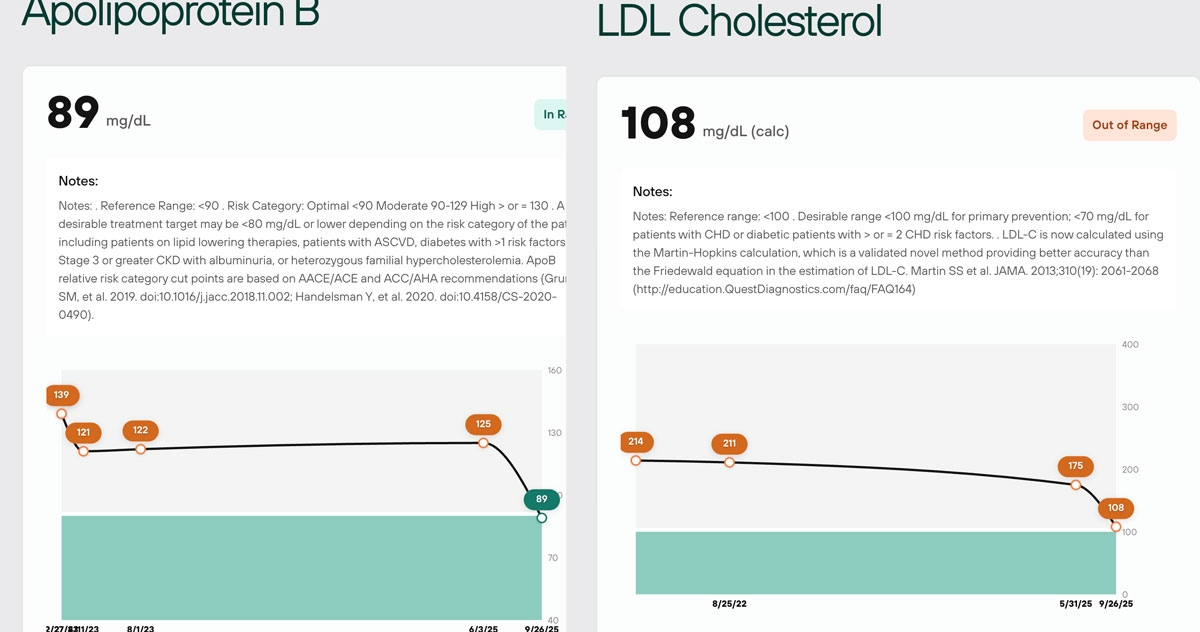
"That's way beyond what I expected from just lifestyle changes," Mike says. Josh had told him he might hit around 100. "To see those numbers—I mean, basically every one of my lipids saw drastic changes. I'm excited to keep monitoring this. I have another lab scheduled for November to track further improvements."
Beyond the numbers, something else has shifted. What started as fear has become empowerment—and even excitement.
"Finding out I have coronary artery disease was terrifying at first, but now I have direct visibility into my health. I can see the impact of my actions in real time through my biomarkers," Mike says. "This journey has been kind of fun, despite the intensity. One of the problems is that so many people don't have feedback loops for this information."
For someone who built his career at a company focused on giving people data about their health, Mike is now experiencing firsthand what that visibility can mean when the stakes are highest.
"I feel like I'm finally aligning my actions with what I've always said I wanted to do—prevent myself from suffering the fate of those who came before me," he says. "I'm not just hoping for the best anymore. I'm doing everything I can, and I have the data to prove it's working."
Mike's next goal? Get his ApoB below 70. "I was told that's likely not possible without a pharmaceutical," he says. "But I was also told that LP(a) is genetic and you can't really move it, and I saw about a 10% change. So I want to do whatever it takes."

Learn your ApoB levels and make real improvements
Levels members can test their ApoB levels through Levels Labs, and then use the Levels app to help improve levels by logging meals and setting exercise goals. Click here to learn more about Levels.