What metabolically-informed care looks like in practice
The future of functional medicine isn't more tools—it's one integrated system where real-time glucose data, food logs, lifestyle tracking, and labs flow seamlessly into treatment decisions.

For decades, functional medicine has championed a systems-based, root-cause approach to health. But in practice, the tools have lagged behind the philosophy. Labs arrive as PDFs. Food journals are handwritten or texted. Continuous glucose monitoring (CGM) data lives in a separate manufacturer app. Sleep and activity tracking happens in yet another platform.
Clinicians spend more time assembling fragmented data than interpreting it. Patients struggle to connect the dots between their daily choices and their long-term metabolic health. And scaling this model—adding more patients, more data streams, more complexity—eventually breaks the workflow.
Metabolically-informed care is what happens when that fragmentation ends: when food logs, CGM data, sleep, exercise, and labs flow into one unified system, giving both patients and clinicians a complete, real-time view of metabolic health.
This isn't theoretical. A growing number of functional medicine and integrative clinics are already practicing this way—and the results are transforming both patient outcomes and clinic operations.
What metabolically-informed care means
At its core, metabolically-informed care is care that uses continuous, behavior-level data to guide treatment decisions in real time—not just quarterly lab snapshots.

Learn more about Levels Pro
Extend care beyond the exam room with Levels Pro, the metabolic health operating system that unifies CGM, labs, food logs, and lifestyle data into a single, clinician‑ready view. If you are ready to practice truly proactive, personalized, preventative medicine, partner with Levels and start building measurable cardiometabolic outcomes at scale. Click here to learn more about Levels for practitioners.
Key principles:
1. Real-time metabolic feedback drives behavior change
- Patients see how specific meals, sleep patterns, stress, and activity affect their glucose—immediately, not months later
- Feedback loops are daily, not quarterly, so interventions can adjust as life changes
2. Labs and continuous data inform each other
- Static labs (HbA1c, fasting glucose, lipids, insulin) provide essential baselines and checkpoints
- Continuous glucose monitoring, food logs, and lifestyle tracking show why labs improve or worsen and what to adjust between visits
3. One system unifies patient experience and clinical workflow
- Patients use one app to log meals, track glucose, monitor habits, and see progress
- Clinicians use one dashboard to review CGM trends, food logs, labs, and AI-generated summaries
- No data assembly, no fragmented portals, no manual reconciliation
4. Care is proactive, not reactive
- Coaches or staff monitor dashboards between visits and flag concerning patterns early
- Patients receive timely guidance through the app, reducing the need for urgent appointments
- Clinicians focus on interpretation and treatment strategy, not data gathering
A day in a metabolically-informed clinic
Here's what this looks like in practice:
Morning: Patient Perspective
Sarah, a 52-year-old with prediabetes, wakes up and checks the Levels app. Her overnight glucose stayed stable (85–95 mg/dL), a big improvement from two weeks ago when late-night snacking drove spikes above 130 mg/dL.
She logs breakfast: scrambled eggs, avocado, and berries. The app tracks her glucose response in real time. Peak glucose: 112 mg/dL. Meal score: 8/10. The app reinforces the pattern she's learning: protein-forward breakfasts keep her glucose stable and her energy steady through mid-morning.
Later, Sarah gets a gentle nudge from the app: "You've been eating dinner after 8 p.m. most nights this week. Try moving it to 7 p.m. and see if your overnight glucose improves even more."
She adjusts.
Midday: Coach Perspective
Jenna, a health coach at the clinic, reviews the Levels Pro practitioner dashboard. She's monitoring 30 patients enrolled in the 12-week metabolic reset program.
Sarah's CGM summary looks great: time in range has increased from 60% to 78% over the past two weeks. Variability is down. Food logs show consistent adherence to the meal plan.
Another patient, Mark, is showing more glucose spikes this week. Jenna clicks through to his food logs and sees the pattern: business travel, restaurant meals, late eating. She sends a quick message through the app: "I noticed glucose has been higher this week—travel stress? Let's brainstorm some strategies for your next trip."
No phone tag. No waiting for the next scheduled visit. Proactive support, driven by real-time data.
Afternoon: Clinician Perspective
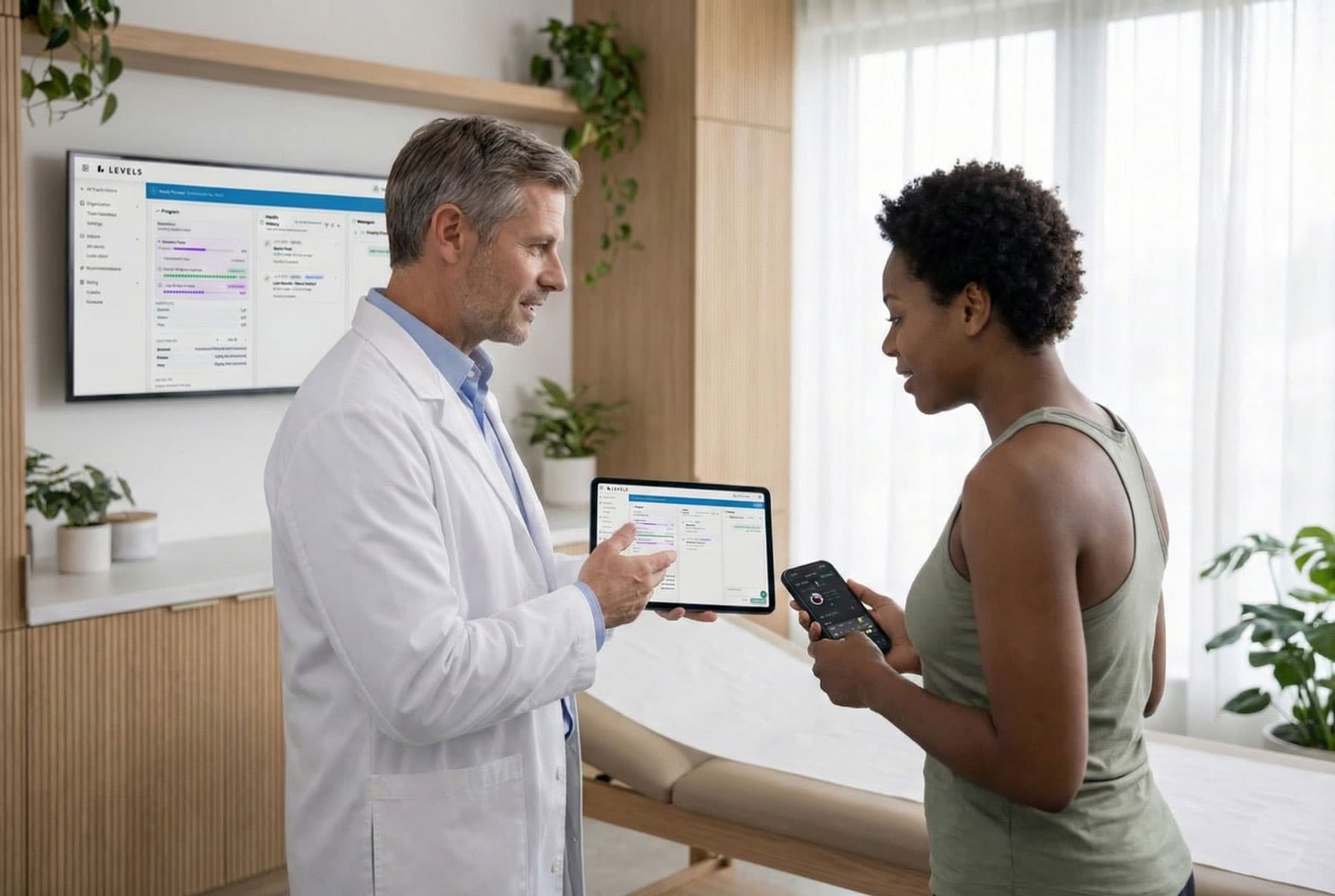
Dr. Chen has a follow-up visit with Sarah. Before the session, she opens the Levels Pro dashboard and reviews an AI-generated summary:
- Time in range: 78% (up from 60% at baseline)
- Glycemic variability: significantly reduced
- Key patterns: glucose spikes correlate with high-carb dinners and late eating; stability improves with protein-rich breakfasts and post-meal walks
- Recent labs (uploaded last week): fasting glucose 98 mg/dL (down from 108), HbA1c 5.7% (down from 5.9%)
The session focuses on interpretation and next steps, not data review:
- Dr. Chen reinforces the behaviors driving Sarah's progress
- They discuss adding strength training to improve insulin sensitivity further
- They set a goal: maintain time in range above 75% for the next month, then recheck labs
The entire visit is efficient, data-informed, and deeply personalized—because all the relevant information is in one place, pre-summarized, and tied directly to Sarah's real-world behavior.
The infrastructure that makes this possible
Metabolically-informed care depends on integrated infrastructure:
For patients: One app (Levels)
- Connects to continuous glucose monitor
- Food logging (photos, quick descriptions, macros)
- Sleep, activity, and habit tracking
- Real-time feedback: meal scores, stability scores, glucose trends
- Educational content and in-app coaching prompts
- Lab uploads and trend visualization
For clinicians: One dashboard (Levels Pro)
- Patient roster with at-a-glance CGM summaries
- Time in range, variability, spike frequency, and overnight stability
- Direct links from glucose events to specific meals, sleep, and activity
- Uploaded labs visible alongside CGM trends
- AI-powered summaries highlighting key patterns
- Secure messaging and care coordination tools
For the practice: Operational efficiency
- Automated enrollment, CGM fulfillment, and onboarding
- Clear team roles: admin handles logistics, coaches monitor dashboards, clinicians interpret and adjust treatment
- Scalable without proportional increases in staff time
What metabolically-informed care enables
When care is built around continuous, unified data instead of fragmented snapshots, outcomes improve:
For patients:
- Faster behavior change (daily feedback loops, not quarterly check-ins)
- Deeper understanding of their metabolic health (personalized, not population-based advice)
- Better adherence (real-time reinforcement is more motivating than abstract lab values)
- Improved metabolic outcomes (time in range, HbA1c, weight, energy, mood)
For clinicians:
- More efficient visits (less time reviewing data, more time interpreting and strategizing)
- Proactive care between visits (coaches monitor dashboards and intervene early)
- Better outcomes with less burnout (integrated systems reduce administrative friction)
For practices:
- Scalable metabolic health programs that don't require proportional increases in headcount
- Recurring revenue from structured CGM programs and memberships
- Differentiation in a crowded functional medicine market
The shift from fragmented tools to unified systems
The vision of metabolically-informed care has existed for years. What's new is the infrastructure to deliver it at scale.
Clinics that continue using fragmented tools—separate CGM portals, manual food logs, PDF labs, disconnected apps—will struggle to grow metabolic health programs without overwhelming their teams.
Clinics that adopt unified systems—one app for patients (Levels), one dashboard for clinicians (Levels Pro)—can finally practice the medicine they've always wanted to: proactive, personalized, data-informed care that scales efficiently and delivers measurable outcomes.
This is what metabolically-informed care looks like in practice. And it's happening now.