Why bad science keeps misleading us about nutrition—and what to do instead
How investigative journalist Gary Taubes learned to spot bad science in nutrition, why that matters for your health decisions, and how to think more like a careful scientist yourself.

When you try to make sense of nutrition advice, it often feels like you only have two options: pick a tribe and defend it, or throw up your hands and decide that nobody really knows anything. Gary Taubes has spent decades living in the space between those extremes. Trained as a physicist and then as an investigative science journalist, he has built his career on a simple but uncomfortable observation: much of what gets published in science is wrong, overinterpreted, or too weak to support the confident claims built on top of it.
In a recent episode of a Whole New Level, Taubes traces how he went from reporting on flawed physics experiments and the cold fusion fiasco to spending 25 years inside the world of nutrition and obesity research. Along the way, he argues that the problems in the field are not just about funding, egos, or social media fights. They stem from a deeper misunderstanding of what good science actually requires and how easily even well-meaning researchers can fool themselves.
The result is a system that continues to generate confident answers about what to eat, even when the data are fragile, contradictory, or never properly tested. For someone simply trying to decide what to do next for their own health, that gap between rhetoric and reality matters.
Here are five key insights from Taubes on how nutrition science goes wrong, how he evaluates evidence, and how you can use that lens to make better decisions in a noisy world.
1. Most published science is more fragile than it looks
Taubes did not begin his career in nutrition. His first two books followed elite physicists as they realized they had "discovered" particles that did not exist and chronicled the cold fusion debacle, which he now describes as "maybe the stupidest scientific subject ever." Those projects left him with a lasting lesson: getting science right is brutally hard, even for brilliant, well-funded teams.
The best experimentalists he met were obsessed with a principle made famous by physicist Richard Feynman. "The first principle is that you must not fool yourself," Feynman wrote, "and you are the easiest person to fool." Taubes says the scientists he most respected "bent over backwards" to look for ways they might be wrong, treating limitations, confounders, and alternative explanations as the core of the job rather than an obligatory paragraph at the end of a paper.
When he shifted into public health and nutrition reporting in the 1990s, Taubes did not see the same culture. In a field where definitive long-term trials are expensive, messy, and hard to run well, many researchers gradually lowered the bar for what counted as "good enough" evidence. Instead of rigorous experiments that could clearly confirm or refute a hypothesis, the field leaned more heavily on observational data, weak associations, and bold interpretations.
The consequence, in Taubes's view, is not that nothing is true. It is that the level of certainty projected to the public often far exceeds what the underlying data can support. For a reader trying to decide what to do differently on Monday morning, that mismatch between data and confidence is where confusion and frustration begin.
2. Nutrition adopted a lower standard of proof---and then forgot that it had
Chronic nutrition questions are uniquely hard to study. If you want to know whether a particular diet causes or prevents a disease that develops over decades, the ideal trial is unwieldy: thousands of people, carefully randomized to different diets, monitored tightly for years, with high adherence and minimal dropout.
Early attempts to run big, long-term diet trials in the 1970s and 1980s did not clearly confirm influential hypotheses, such as the idea that simply lowering dietary fat would reliably prevent heart disease. Faced with that reality, Taubes says, the field had a choice. One option was to admit that, for many questions, "we don't know" was the honest answer. The other was to keep giving public advice anyway, but to rely more heavily on weaker evidence: shorter trials, looser adherence, observational studies, and surrogate markers.
In practice, he argues, many nutrition and public health leaders chose the latter. "It's as though, when confronted with the reality that you can easily fool yourself, they just decided they were unlikely to be fooled," he says. The urgency of giving people guidance---"we have to tell the public something"---was used to justify softer standards of proof. Over time, that compromise stopped being framed as a compromise and simply became how the field worked.
Today, even high-profile nutrition journalism often reports these weaker studies as if they were decisive. In a different domain, Taubes notes, this kind of evidence would be treated as circumstantial. In nutrition, it still often becomes the basis for sweeping recommendations delivered with the tone of settled fact.
3. Good scientists foreground uncertainty. Bad science hides it.
Because Taubes has spent so much time around both careful and careless researchers, he has developed a simple filter: pay attention to how a scientist talks about uncertainty.
The scientists he came to trust were explicit about the limits of their work. They cataloged confounders and design flaws. They emphasized what their data could not prove. They mapped out alternative explanations and sketched the next experiments that would be needed. Historically, he notes, older research papers often devoted large sections to limitations. By contrast, many modern nutrition papers tuck a few perfunctory sentences into a short "limitations" paragraph, then move quickly to strong conclusions.
He applies the same lens in conversation. When a prominent scientist insists "there's no controversy" around a topic that is clearly debated---for example, the link between salt and hypertension---Taubes takes that as a warning sign. "Good scientists never say things like 'there's no evidence,' because there's always some evidence," he says. "If people are arguing, then by definition there is some data someone finds compelling, even if it's flawed."
For lay readers, this distinction matters because most of us do not have time to reanalyze datasets ourselves. We end up leaning hard on experts. Taubes's point is not that credentials are meaningless, but that you should notice how an expert relates to doubt. A willingness to spell out how they might be wrong is a much stronger signal of reliability than the prestige of their institution.
4. Paradigms shape which questions get asked---and which evidence we ignore
Taubes believes one of the deepest problems in nutrition science is not any single bad study or biased researcher, but the underlying paradigm the field has taken for granted. For obesity, that paradigm is energy balance: the idea that body fatness is fundamentally about calories in versus calories out.
As a statement of physics, this is obviously true; energy is conserved. If you store more energy in your body, you must have taken in more than you expended. But Taubes argues that this description is not an explanation. To make the point, he borrows a financial metaphor. "You would never say Bill Gates got rich because he made more money than he spent," he says. "That statement is technically accurate, but it tells you nothing about why he became rich and other people did not."
Earlier generations of European researchers, especially in Germany and Austria before World War II, took a different view of obesity. They saw it less as a willpower or accounting problem and more as a disorder of fat storage governed by hormones and the nervous system. In that frame, hunger, appetite, and weight gain are downstream of underlying physiological states, not the simple result of gluttony or sloth.
World War II, emigration, and the rebuilding of medicine in the United States disrupted that line of work. As Taubes tells it, many of the researchers who had been thinking in hormonal and constitutional terms vanished from the literature, and the next generation defaulted back to the more intuitive energy-balance story. Once that story hardened into dogma, it shaped everything else: which hypotheses were considered serious, which trials were funded, and which anomalies were ignored.
"When you assume from the start that people are fat because they eat too much, you end up designing a whole world of research and advice around that assumption," he says. Evidence that does not fit---lean people who eat a lot, people with obesity who do not overeat, cultures that only develop obesity after adopting certain foods---tends to be explained away rather than treated as a clue that the paradigm might be wrong.
5. You do not need perfect science to run your own experiment
After decades inside these debates, Taubes is clear on two points that can feel contradictory: the science is messier and less settled than most headlines suggest, and yet individuals still have to make real decisions about what to do tomorrow with their bodies and lab results.
At the population level, he believes we do need better, more rigorous trials to adjudicate between models and guide public policy. But at the individual level, he argues that you do not have to wait for the perfect randomized controlled trial to see whether a particular approach helps you.
"If you've struggled with your weight, you've almost certainly already tried the standard 'eat less, move more' advice," he says. "You know how that's gone." One reason low-carbohydrate and ketogenic diets keep resurfacing, he suggests, is not just marketing but lived experience. A meaningful subset of people report dramatic, sustained improvements in weight and appetite when they follow these diets carefully.
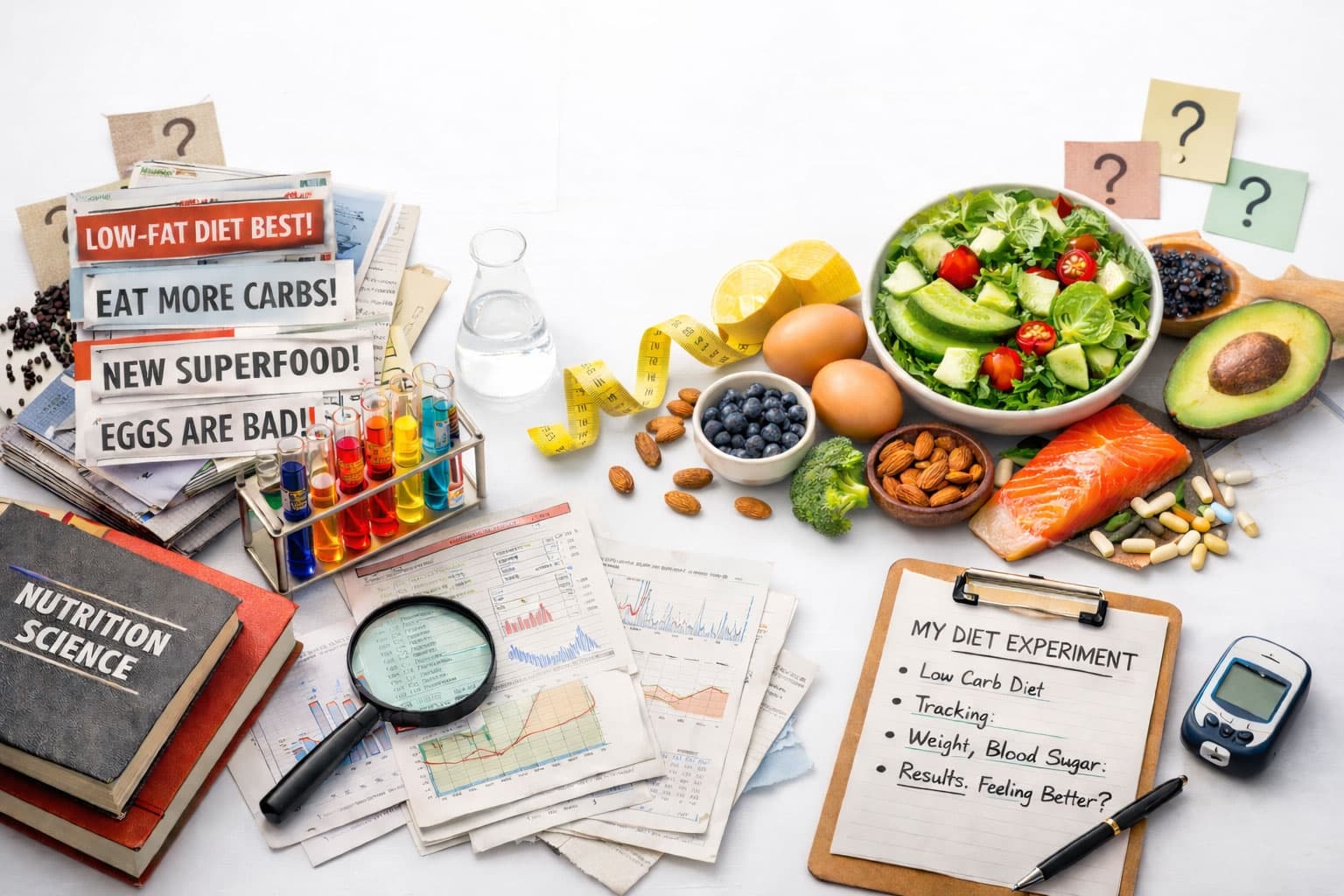
Taubes encourages people to treat dietary change like a genuine experiment they are running on themselves. That means committing for long enough---on the order of six weeks to three months---that you are not just testing willpower for a few days. It also means implementing the diet in a way that actually matches the underlying hypothesis. "A true low-carbohydrate diet is very different from simply 'cutting back a little on bread,'" he says.
"You don't need a clinical trial to tell you whether a ketogenic diet works for you," Taubes says. "What you do need is a clear time frame, a faithful version of the diet, and some basic tracking of outcomes: weight, hunger, energy, and, when possible, lab markers." At the end of that period, you may decide the tradeoffs are not worth it and return to your old way of eating. Or you may decide that feeling better and having more control over appetite matters more than the convenience of certain foods.
Either way, you end up with real data about your own body, not just abstract arguments.
Conclusion: Better questions, more honest answers
Taubes's core critique is not that nutrition scientists are uniquely bad or corrupt. It is that any field dealing with complex, long-term human outcomes is vulnerable to self-deception if it drifts away from the habits of good science: ruthless honesty about uncertainty, rigorous testing of core ideas, and genuine curiosity when observations conflict with the dominant story.
For someone trying to navigate their own health, that perspective suggests a different kind of skepticism. Instead of bouncing between diet tribes or giving up entirely, you can:
- Notice when confident claims rest on surprisingly weak evidence.
- Favor explanations that respect basic physiology, not just simple slogans.
- Ask whether a recommendation would still make sense if the underlying hypothesis turned out to be only partly true.
- Run careful, time-bound experiments in your own life and pay attention to the results.
We may be far from definitive answers to all of nutrition's biggest questions. But we are not powerless. By borrowing some of the habits of good scientists---and staying alert to the ways bad science creeps in---you can move from passively receiving advice to actively testing what works for you.
FULL TRANSCRIPT:
Why Nutrition Science Got It WRONG & the Case for the Carb-Insulin Model | Gary Taubes & Mike Haney
In a recent episode of A Whole New Level, Levels editorial director Mike Haney sits down with Gary Taubes, an investigative journalist who has spent decades researching nutrition science and obesity. Taubes is perhaps best known for questioning the conventional wisdom around dietary fat, salt, and the causes of obesity—not as someone pushing a predetermined agenda, but as a journalist who stumbled onto what appeared to be profoundly flawed science.
The conversation covers a lot of ground: how Taubes got into nutrition research after investigating bad science in physics, what makes nutrition research so difficult to do well, why he believes the energy balance model of obesity is fundamentally wrong, and what the carb-insulin model offers instead. They also dig into how to evaluate nutritional research when the field is full of conflicting claims, why the conventional advice to "eat less, move more" may be missing the point entirely, and what kinds of studies would actually give us reliable answers.
Throughout, Taubes makes the case that obesity isn't about willpower or eating too much—it's about hormonal regulation of fat storage, primarily driven by insulin. And if that's true, the implications for how we think about diet, weight, and health are profound.
"You would never say Bill Gates got rich because he made more money than he spent. The same laws are at work in the energy balance thinking—it tells us nothing about why one person is obese and the other person isn't."
From physics to nutrition: How Gary Taubes became an investigative journalist in the nutrition space
Mike Haney: Gary Taubes, welcome to the show.
Gary Taubes: Thank you for having me.
Mike Haney: We'll touch on a few things today. I'll set some context for where I want to go and what I'm super curious about getting into with you.
One of the things I want to talk about is the carb insulin model of obesity, maybe models of obesity in general, what we know about why we get fat. And maybe even to separate a bit why we get fat versus how we lose weight, which feels like they might be slightly different conversations. Related, right? But maybe slightly different.
But I also want to talk about, because of your background as a journalist and as a journalist who's really focused on what we call pathological science, bad science, particularly in the nutritional world—I know it's not where you got your start, but you've spent now several decades in the nutritional world of science—just how we think about nutritional science and really how people can make sense of what they're hearing, what they're seeing, debates that happen, especially now in social media, right? Where everybody's got a point of view, everybody can defend their thing as though it is God's honest truth, and how we know what we know versus what we don't know.
Because that's usually my mission on this show. And as an idiot journalist myself, I say that—you've spent decades researching this stuff. I haven't. So, I usually come to this representing an audience who's curious and I'm willing to take the time to read the papers and watch stuff and then try to synthesize as best I can how to make sense of it.
But that's usually my mission is just to help people who don't have the time to do that, but want to know not even the answers, but want some sense of what to do and don't want to just hear all the screaming back and forth. How do we make sense of this? What do we do about it?
That's where, within the fields of obesity and within the fields of nutrition research in general, I'd love to touch on. I won't make you go through your whole background because you've done that on a lot of podcasts. It is super fascinating. I encourage folks to go out and listen to any of the other shows that you've done, but maybe instead of going all the way back to CERN and some of your early work that you did in your physics degree, maybe we'll just start with how you got into the nutrition research side.
Because I do think this is instructive—that you come at this not as a researcher or a scientist who had a hypothesis and was trying to push something, but you came at this from really the complete opposite angle of stumbling on something and going, this doesn't seem like it holds water. That feels like there is bad science happening in this space.
Gary Taubes: To set that up I will have to step back just a sec.
My first two books were about bad science. First in high energy physics—I lived at CERN as you mentioned with a group of brilliant scientists. I was embedded, we would say today. I spent 10 months with them. I watched them realize they had discovered non-existent elementary particles and they had, in a sense, screwed up. And I watched them learn how they had done it and then I watched them decide what to do about it.
My second book was on cold fusion, this great scientific fiasco of the 20th century. I interviewed like 300 people for what may have been the stupidest scientific subject ever. But this getting things wrong in science is the natural condition of science. Some huge proportion of everything that scientists do and report and that's in the journal articles, that's reported in the newspapers, are just wrong or misinterpreted or over-interpreted.
And I became obsessed with how hard it is to do science right. I stumbled into public health research writing for the journal Science as a freelancer, a correspondent in the 90s.
One day I needed a paycheck. I called up my editor and I said, do they have a story I could turn over quickly so I can get a paycheck, pay my rent? And it was the DASH diet study, dietary approaches to stopping hypertension, and it was being published in the New England Journal of Medicine. Copy had been leaked to Science, although I didn't know it, along with the copy. They'd been given a list of people to interview.
So, you know how you do these stories, right? You get the paper, it's embargoed. So, you call up the principal investigator, he tells you what they did, you ask him or her who to interview, and they give you the names of a couple people who know about the research, even though it hasn't been published yet. You call them. If you've got three people, you can write a page of copy.
Mike Haney: Yep.
Gary Taubes: Get your three quotes, get your paycheck, pay your rent.
I had the PI. I interviewed the PI, but I also had this list of other people to talk to. One of them was a former president of the American Heart Association, and she told me she could not speak to me about this study and she would not speak to me about this study.
And I said, why won't you speak to me? She refused to talk. I said, let's go off the record, à la Woodward and Bernstein. If I don't know why you won't talk to me, what's wrong with this study, I'm going to commit some kind of journalistic sin by writing it up, right? And I just wouldn't do it.
And then I called one of the people the principal investigator had given me and he started telling me there was no controversy over salt and hypertension. And I said, but I'm not calling about salt and hypertension. I'm calling about this DASH study, a diet study in New England Journal. And he kept yelling at me that there's no controversy.
I got off the phone with him and I called up my editor and I said, I'm going to write up the story because I need the paycheck. But I had a former president of the American Heart Association refuse to speak to me about the research, even off the record. And I had this other guy yelling at me that there's no controversy over salt and hypertension when I wasn't calling about salt and hypertension. There must be a controversy over salt and hypertension that we know nothing about. And that's the only way to explain this.
So when I'm done, get my paycheck, I'm going to dive into this and see what I could learn. I spent the next nine months on one magazine article. I interviewed like 80 odd people. I read all the literature in the field. I actually printed out stacks of all the major papers which is about a foot deep. And I sent them to three epidemiologists—well, two epidemiologists and a biostatistician that I knew who were really good critical thinkers, but had never been involved in this salt hypertension debate.
And it turns out that the evidence that high levels of dietary salt cause hypertension and heart disease as a result and stroke—the evidence is terrible. And there had been this very vitriolic debate about it.
And the guy who had yelled at me that there's no evidence that salt is not the driver of hypertension was clearly one of the worst scientists I'd ever interviewed in my life. Good scientists never say things like "there's no evidence" because there's always some evidence. If there's a controversy, clearly there's some evidence because otherwise people wouldn't disagree with you.
So I ranked him as maybe in the bottom five of the worst scientists I'd ever interviewed. And I'd written this book on cold fusion that was called Bad Science. And I thought I had interviewed the worst scientists in the world then because things like cold fusion collect bad scientists.
And anyway, he then took credit for getting Americans not just on the low salt diet we were all eating, but the low-fat diet. And so when I got off the phone with him again, I called my editor. I said, when I'm done writing about salt, I'm going to write about fat. I have no idea what the story is, but if this guy was involved in any substantive way, I know there's a good story there.
And I spent a year on an investigative piece on the fat science. It turns out that the evidence that dietary fat causes heart disease by raising cholesterol is terrible, been over-interpreted for 40 years now. Both those investigations won awards, the National Association of Science Writers Awards, and it just convinced me that there's this very fertile world of bad science that I could explore.
Back then, I basically believed the conventional wisdom. I had a low-fat diet, lots of fruits and vegetables and whole grains, everything I was supposed to be eating. And I haven't been able to get out of that world ever since. And it's just from a research perspective as an investigative journalist turned historian now, it's this incredibly fertile field. Learning about how scientific dogma develops, how other belief systems are rejected or ignored or never get the foothold they need to potentially prosper.
What makes nutrition research different—and harder—than physics
Mike Haney: I want to come back to the thing you just said there about not being able to get out of this space because you have been in it for a very long time.
But I'm curious within that first salt article deep dive that you did—you were an investigative journalist. You were accustomed to the notion of spending a long time going very deep, but what did you learn about going deep in the nutritional space versus what you had been doing in the past?
Nutrition studies are in some ways pretty different than physics studies. The way the scientists approach the science is even I think fair to say different.
What did you learn about reporting on nutrition and just what surprised you as you did that investigation?
Gary Taubes: Well, so this was a revelation I had originally had earlier when I was writing these books about bad science. At first the high energy physics and cold fusion, I was getting the lesson that was being hammered into me by some of the best experimental scientists in the world—how meticulous and rigorous and critical they had to be.
There's a famous quote from the Nobel laureate Richard Feynman: "The first principle of science is you must not fool yourself and you're the easiest person to fool." And these people, basically all my books were learning experiences in how easy it is to fool yourself in science and how critical you have to be and how meticulous to make sure that what you think you're seeing is real and not just the creation of the equipment that you're using to see it.
The scientific method in general is just hypothesis and test. So in physics you get a hypothesis or when you create your tests, all the particles for all intents and purposes are the same. You can reproduce exactly whatever experiment is done.
In nutrition, the tests of hypotheses are clinical trials. You have to use humans to do the studies. You're testing a hypothesis that a particular element of the diet creates a chronic disease—say diabetes or obesity or hypertension—and chronic diseases take years to develop. So you have to run the experiments for years. You might need 10,000 or 50,000 participants. You have to randomize them to one diet or another diet or to low salt foods or high salt, and then you have to keep them on those diets for the extent of the studies and it's virtually impossible to do. It's certainly extremely challenging. In many ways, it's probably harder than doing the avant-garde of physics experiments.
So what the nutrition public health community did when confronted with this kind of challenge and the inability—back in the 70s and 80s they funded studies to try and test their hypothesis and the studies failed to confirm the hypothesis and they decided this was probably a failure of the test. And so they decided they would lower their standards and accept the hypothesis as very likely to be true based on non-experimental evidence.
And we can get into this story, but it's as though when confronted with the reality that the first principle of science is you can't fool yourself and you're the easiest person to fool, they just decided, well, we're unlikely to be fooled, so we don't have to worry about it.
And it's so important that we give public health advice about diet, that we tell people how to eat now that we've established that there are probably these chronic diseases that are diet related. They just lowered their standards. And you could argue, as I had, that when you're giving people advice like a physician telling a patient what to do, you should have the highest standards of evidence. They instead decided they would allow themselves to get by with lower standards.
And now this has become such the norm that the world is full of very high-profile science and nutrition journalists who don't even notice that they're reporting on evidence that would be unacceptable. In effect, if it was a criminal case, it would be reporting on circumstantial evidence and claiming that it was reason for a particular defendant to be convicted and it's just not.
So you have a situation where it's extremely difficult to do the studies. We all want to know what to eat and how to eat healthy. And we have a nutrition research community that won't do the hard work to really establish what the reliable knowledge is. And then we have intermediaries and nutrition journalists and the social influencers who don't really care. They just see their job as reporting what they're told by the researchers as though it's true, and yet they should know that it's not.
"The first principle of science is you must not fool yourself and you're the easiest person to fool. In nutrition, they just decided, well, we're unlikely to be fooled, so we don't have to worry about it."
The challenge of doing good nutritional science
Mike Haney: So when you say that the nutrition research community won't do the work—I mean, is the conundrum here that these nutrition studies are hard to do, expensive, take a long time because of the time it takes to develop things, because people are just messy, right?
Or you've got the epidemiological side where you're just looking for associations and doing your best to control for things but you're essentially just—those are sort of your two models, right, of doing?
Or you do the animal research or the cell research so that you can at least prove a mechanism and then either that becomes your explanatory device—well, look, the mechanism works so it must explain what we see over here even though we don't have the five-year 100,000 person RCT to prove it.
I mean there's a conundrum that this kind of research is just hard to do, yet there is this feeling of urgency. If people—if we assume people go into this field because they want to make the world a healthier place, whatever—they feel an urgency to tell people what to eat. You see increasing rates of diabetes or obesity.
And so how do you square that circle? How do you deal with the fact that these things are hard to do? You said they're not willing to do it. Who's they? Who's not willing to do that?
Gary Taubes: Well, the community at large doesn't see the need to do it. Because if they did, if they would get together and make that point, I keep waiting for nutrition researchers to say, let's—we just don't really know if what we're advising is true. I mean, it falls apart on so many levels.
For instance, what could be more obvious than that we should all eat fruits and vegetables, that fruits and vegetables should be a healthy part, a necessary part of a healthy diet? Okay. Well, leaving out even whole grains at this point, just fruits and vegetables.
If you actually go look at the evidence for the belief that fruits and vegetables are necessary for a healthy diet—and I mean, on one level, it's a dogma that was created in the 1930s because you had this period where nutrition science starts in the 1870s studying basically what you can measure. What you can measure back then is the energy content of foods and the energy expended in these devices called calorimeters. You could measure how much protein people ate by measuring the nitrogen in their urine.
And then you move from that kind of nutrition science into the vitamin science of the 1920s and 1930s which is known as the new nutrition. And they established that various deficiency diseases like scurvy and beriberi and rickets were vitamin deficiency diseases.
And so this idea was: we know that there are these vitamins in foods that if people don't get enough of the vitamins, they suffer these diseases and they're in various different foods. So we're going to tell people to eat as many foods, different types of foods as possible, all the different food groups. And that way we'll maximize the possibility that they'll get all the necessary vitamins they need to avoid these deficiency diseases.
Among other things, the orange juice industry had all these oranges they wanted to sell and orange juice. So they pushed the need for vitamin C and oranges become a source of vitamin C. So industry gets involved and health-conscious mothers are telling their kids they should eat green vegetables and the more vegetables the better. And you never actually have research showing that the presence of fruits and vegetables in a diet make any difference.
In the 1960s and 1970s, you get observational studies where they look at populations that are healthy. Look at populations and compare the healthy people to the unhealthy people. The healthy people tend to be higher socioeconomic status and they tend to be more health conscious and they tend to eat less junk food.
And junk food is sugar and refined carbs, right? It's candy and ice cream and crackers. And so they don't want to tell people that they shouldn't eat candy and ice cream and crackers because that's like the nanny state. But they notice that the healthier people tend to eat fruits and vegetables instead of those foods.
So they start—this becomes the birth of the idea that fruits and vegetables are an inherent part of a healthy diet because health-conscious people eat those foods. It's never actually tested. The few times they've done clinical trials that could have tested it, the most famous is the Women's Health Initiative, it doesn't seem to make any difference.
And now it's 2025 and you have a whole world of people who eat carnivore diets. So they don't eat fruits and vegetables. I'm assuming they don't take vitamin supplements, but I could be wrong. They have no fiber in their diets because they're only eating animal products and they at least appear or claim to be very healthy.
Okay, so this violates everything, all these fundamental tenets of nutrition science. They're clearly not getting vitamin C from fruits and vegetables. They're not getting fiber, which is assumed to be necessary for a healthy diet. They're not getting all the phytonutrients in broccoli and the green leafy vegetables.
Why aren't we getting studies of the carnivore population to understand whether or not—maybe they're all lying. They're all on supplements. Who knows? Maybe they sneak out and take Metamucil every other day so they can have bowel movements. Who knows? I mean, but this is the kind of thing—if you were a nutrition researcher, at what point do you say, wow, the existence of this weird dietary subgroup seems to violate everything I know about healthy diets.
If you're a physicist, that's the most exciting thing you can imagine. An observation that conflicts with your belief system. In nutrition, you get no interest. They're written off as diet faddists. The world is full of diet faddists. You could find people who live on potatoes and people who live on oranges. There are fruitarians, right? But why aren't they studied?
It's a fundamentally different approach to doing science. Like we know what the truth is. When confronted with evidence that conflicts with that truth, we are going to for the most part ignore that evidence or write it off as some weird human subgroup and make no attempt to learn whether or not we are fooling ourselves, which should be the one thing we're always foremost in our mind.
What kind of studies would give us real answers?
Mike Haney: Can you describe a study you would like to see? Like if we take the idea that vegetables are healthy for you or that carnivore turns out to be a healthy diet.
I mean, there are studies out there on all of these things. I take the point that there may not be the kinds of studies we would want to see or they may have limitations or whatever, but there's people that have looked at carnivore populations. And my read of this stuff is it's usually pretty mixed. You can find examples of carnivore people who do really well and you can find examples of carnivore people who don't do as well. And you could say the same about vegans and you could say the same about keto folks, right?
So, what kind of studies would give us the kind of evidence that you'd want to see to go like, okay, now finally the nutrition community is doing what it's supposed to be doing?
Gary Taubes: Well, if I were to study the carnivores, the first thing I would want to do is—and this was actually done in two subjects in 1928—put an ad out, recruit 50 people on carnivore diets, have them come live at my laboratory, and eat nothing but meat, animal products for a year. Let's see what happens.
When I say it was done in 1928, this is the way it was done: there was a Harvard anthropologist turned Arctic explorer named Vilhjalmur Stefansson and Stefansson spent a year and a half in the Arctic. Actually, I think he might have spent the better part of a decade in the Arctic. Very controversial character.
He comes back saying, look, these Inuit are the healthiest people I've ever seen. They're just—they'll run alongside our dog sleds for 25 miles without getting tired. They're just unbelievably healthy. And people said, and they don't eat any vegetable products. And the response was, well, they're probably genetically adapted to that diet.
He said, but you don't understand. When we go live with the Inuit, we don't eat any vegetable products, any plant products because there are none and we become extremely healthy.
The nutrition community at the time put together a panel of like 10 of the leading authorities and they had Stefansson and a guy named Karsten Anderson I think his name was, live in a ward at the Russell Sage Institute which was in lower Manhattan and I think it's part of Cornell now and they fed them nothing but meat. I think Stefansson was an inpatient for something like 3 weeks and then they trusted him because he had things to do to continue living on meat and they could also check his urine regularly for probably ketones to see if he was cheating or not. Anderson stayed in for something like three months and then they put him on an honor system and at the end of a year they published something like 11 papers in the medical journals and basically everything about them got healthier, even their toe fungus and their gingivitis improved.
And when Stefansson later wrote a book in 1940 or 41 called Not by Bread Alone on the Inuit and this diet, the leading nutritionist of that era, a guy named Eugene DuBois wrote the introduction to the book and said we are going to have to rewrite everything we think we know about nutrition just based upon these two guys in this experiment 13 years ago.
And maybe because it was the beginning of World War II, maybe because it was just too radical a message. Maybe because even back then if you tell people that they'll be healthier if they don't eat carbohydrates, you're lowering the hammer on virtually every major American food industry except the livestock industry. Nothing ever came of it after the war.
It's just conventional wisdom floods back and 60 years later we're told that fruits, vegetables, whole grains, and legumes have to be the basis, the absolute necessities of a healthy diet. It's repeated over and over again. I eat vegetables and I eat fruit and I do it because my mother told me to when I was younger. But I have no idea if I'm healthier because of it. And will I live longer because of it? Will I keep my faculties longer because of it? Will my blood pressure stay lower? Will I be less likely to have a stroke? There's no way to know without a clinical trial. And no one's ever going to do that trial.
Mike Haney: And does that get back to—I mean, in the example you just gave, right, one way to interpret that, you could say, well, the reason that that didn't go anywhere is because it was a trial of two people, and that's never going to tell us enough, right? Because it's two people, and who knows? These guys are genetic weirdos. These guys did something else, whatever. Like I feel like you're also saying here that there is a lot of power in the kind of anecdotal things. We look at the carnivore folks, they seem to be relatively healthy, but also to get the kind of robust research that you would want to see in any field, but particularly here, what we want is much larger, much more controlled trials.
Gary Taubes: Doesn't necessarily have to be much larger. Does have to be well controlled.
And one of the interesting things, so I've spent the last couple years of my life—my next book is going to be on the history of obesity research and I've done nothing but read research on obesity and thinking on obesity going back to the 19th century. And because of AI now I can translate the German language literature and the Russian language literature and Hungarian. It's like pick a language. If I can find an article on obesity, I can translate it.
So this idea that you do have to do large clinical trials grew out of the pharmaceutical industry because basically you're testing drugs that have small effects, subtle effects. And when you have subtle effects on prevention or treatment, you need enough people that you can see whether the benefits outweigh the risk.
So for instance, when insulin was discovered, it was tested on one young boy in I think it was January 1922 who was on the verge of death. It brought him back to life. The Canadian scientists who purified insulin, then tested it on four or five more. They wrote a paper about it that was published like a month and a half after the first case in the Canadian medical association journal. And then they picked like six or seven leading diabetes specialists from around North America and they sent them insulin and they had them use it on their patients to see if they could replicate what happened.
So everything starts with one anecdote, one patient. And if it works on one patient, you use more patients. But now you're looking at treatment. You're not looking at prevention of disease. You're looking at treatment of disease. And for treatment, you can expect reasonably quick results. If you don't get reasonably quick results, then you need longer trials and larger trials.
There are questions you can ask that only require a few patients. You want to maximize the control you have over the patient. So, you don't want to say, I want to know if a carnivore diet's going to kill somebody. So the problem is if we just look at people who are eating carnivore, maybe the ones that we're studying are the ones who it didn't kill, right? And we're not seeing those because they're dead or they got sick and they swore off it.
So let's take 20 people and randomize 10 of them. Let's just take 20 people at random and have them eat carnivore, but we want them well controlled. We want to make sure they're eating nothing but meat. So the number of patients, participants you need to get a pretty good idea what this diet does in the short term to the average human being isn't that many people.
You're right. Two people could be freaks. But those two people have completely refuted everything that the nutritionists thought they believed. Leading nutritionists of that era had predicted they'd be dead within three months from scurvy and neither one of them—I mean they were both clearly healthier afterwards than before. That's a revelation even if it's possible that if you had given it to 30 people the other 28 would have died of scurvy. But it's unlikely. The fact that they were both Arctic explorers could bias it, but it's a revelation one way or the other.
So on some level all medical advances start with some kind of observation that can be one anecdote, one individual. And then the way medicine used to progress is if it works on one patient, you try it on others. Maybe I've written about this in many of my books and it'll show up in the obesity book too.
And then if it works on say three of your patients then you write a paper about it and you're telling other doctors, look here was a condition—like using insulin to put weight on infants that aren't thriving, that are failing to thrive. It was used very quickly in the early 1920s after it was shown that insulin could do this for type 1 diabetics. Maybe it could do it for infants who are failing to thrive. So a physician tries it. It works. He writes a paper. Another physician tries it and says I read this paper. So I tried it and it worked and it just goes from there.
And by the 1930s it's a standard of care for putting weight on emaciated people and infants is insulin therapy. Depending on the question you're asking, there are some questions that can be answered with very few subjects.
But you have to know it's by being well controlled. You have to know that subjects are doing exactly what you think they're doing and they're not claiming to do it. Like, oh yeah, I'm eating nothing but steak, but when I go home for lunch with my family, I do have ice cream and black beans. So you have to make sure that you know that's controlled, but it could still be very few subjects.
"Fat goes from being a storage depot to a burden. This injustice is being done constantly—people grow up with obesity and think on some fundamental level it's their fault because they ate too much."
How to evaluate nutrition research when you're going deep
Mike Haney: When you—I mean you famously when you've done all of your books, even your magazine articles, go very deep, right? You read hundreds of studies on this stuff. How are you synthesizing that? What are you looking for in all of that research? Because I have this problem every time I'm trying to do a piece where you can almost endlessly go down any rabbit hole and at some point, you know, usually your deadline, you have to go, well what's my best synthesis of it? Or the shortcut that a lot of journalists take is you call an expert and you ask them and the expert tells you, oh well it's this. Now the danger of doing that particularly in the nutrition world is you can find a nutrition expert who'll tell you anything, right? So you have to really be careful in this field not to have that sort of hypothesis going in. But when you're doing that long a research and you're reading that many studies, and if you're going in without the pre-formed hypothesis that maybe the nutrition researchers—because they're trying to conform or they're trying to get funding or whatever, you're going in as an apparently neutral observer going, maybe the fat people are right, maybe they're wrong. I don't know. I'm just going to go find out. How do you arrive at a conclusion? How do you—what signals are you looking for in that research?
Gary Taubes: So my bias—I'm looking for people. Remember because I had studied bad science in my first two books and I had the remarkable opportunity to be mentored by very good scientists, exquisite experimentalists. I mean they really knew their business and they could be that in chemistry and physics and nuclear physics. So I had learned how they thought about interpreting evidence.
And so as I'm interviewing people, I'm making judgments about how they're interpreting the evidence. Are they aware of how easy it is for them to fool themselves? Are they discussing the evidence in that sense? And somebody who does is somebody I'm concluding is a good scientist. And somebody who doesn't is somebody I'm concluding is a bad scientist.
As I'm talking to people, I'm making these judgments and I hope I'm not deciding what to believe based about the scientists based on whether or not they agree with me. Like I develop a bias early. They agree with my bias. But I'm making these judgments based on whether they satisfy my criteria for what constitutes a good scientist, which is basically, and again, Richard Feynman says they bend over backwards to be honest about all the limitations of their evidence and all the problems and all the challenges and what they can and cannot conclude.
And in that way, I will make judgments about what to believe based on what the people who I think are better scientists believe. When you read papers, you can make the same kind of judgments about whether they're doing that in the paper. Are they paying attention to all the ways they could be fooled? Are they discussing in the limitations section of the paper? Are they just assuming they got the right answer?
Nowadays, when you read the old literature, like 100 years ago, the limitations section of a paper could be 50% of the paper. Now, it's a paragraph where you say, well, we didn't do this, but this is why it doesn't matter, and we didn't do this, but this is why it doesn't matter.
And I keep doing the research. I hate writing, so research is a great procrastination tool. So basically, you keep doing the research until it's just blindingly clear that you are not learning anything new and everyone I interview, I say, who else should I talk to in the field? Like, who do you respect? Who's good? And after a while, you don't get any new names. Like the last 10 people I've interviewed have all said the same people who I've already interviewed. So I can be fairly confident that I've gotten everyone.
Because I've ended up questioning the conventional thinking, I have to be more certain than I would be if I was agreeing with them. And one of the issues with conventionally, as you put it, one of the ways you do this job is you just call the experts, right? So I got to write a piece and you see this all the time in the New York Times and every major newspaper. It's like I have to write a piece on nowadays Robert F. Kennedy Jr. and the MAHA movement is fashionable. So we're going to write a piece about that and we're going to criticize it and I'm just going to call up somebody at Harvard, somebody at MIT, and somebody at ideally some other Ivy League institution or Stanford and I'm going to quote them explaining to me why these MAHA nut cases are wrong. And that's my reporting.
But if you start to question the conventional wisdom, you can no longer just call up authorities and quote them like it means anything. And that really got tricky.
My first book on nutrition, Good Calories, Bad Calories, which I mean I interviewed I think 600 odd researchers, administrators, authorities for this book. I realize as I'm doing it, I can no longer just quote the authorities and I can't even really just quote their studies because I know that they're not good. I have decided that for the most part they're wrong and they're wrong because they don't have a culture of good science. And it makes it a very difficult book to write because you want to be compelling, but you could no longer be compelling just by saying so and so at Harvard said so. Because 50 pages ago, I suggested that so and so at Harvard was a bad scientist. It isn't easy, but it becomes the job.
One of my favorite—when my sugar book came out, The Case Against Sugar, I got a long review in The Atlantic by this then very good science writer named Dan Engber who has since become an editor and writer for the Atlantic. And in it he said that I was in this weird position as a journalist because I had decided that I seemed to know the science as well as some of the scientists. And then my judgments—I trusted my judgments more than theirs. And it is a very weird position to be in. But you do your homework. It gives you an advantage over people no matter how many letters they have at the end of their name.
The field of journalism, when somebody assumes that their sources know better just because they're an academic—if you want to learn about the Middle East, Israel and Gaza, you trust what's his name, Tom Friedman at the New York Times, as much as you might trust somebody who happens to be a professor of Middle Eastern history at Brown. But in nutrition and public health, the journalists are not supposed to be able to judge as though we haven't been educated. But if you do your homework and you're reasonably intelligent, then we have advantages that the researchers themselves don't have. Like I can call up everyone and actually interview them. Researchers won't do that. They won't call up their critics or their peers and say, let me talk to you about this. They should, but they won't. It's not part of what they see as their job.
Understanding the carb-insulin model of obesity
Mike Haney: Well, yeah. I mean, it does point to that conundrum, right? If you're talking about a field in nutrition research in which most of the research is flawed in some way, in which either for good faith or bad faith reasons, there's a lot of flawed research out there. It feels like it amplifies this problem then of how do you arrive at some kind of conclusion? Like listening to you talk about all of the kind of research that you've done around these topics, I wouldn't be surprised if you went down this beat and your conclusion was nobody knows anything. We don't understand obesity. All of these studies are flawed. But instead you arrived at a model that you felt was correct or at least holds water. And it feels like maybe even with the salt and maybe even with the fat articles, you did arrive at—you didn't arrive at what could have been a reasonable conclusion, which is we just don't know, right? And the public doesn't want to hear that. But look, you could get away with saying that. You could get away with the conclusion of the Times cover story being, look, so and so is saying this, the mainstream is saying this. I'm not saying they're wrong. What I'm saying is we don't know and they don't know either because the science is just bad, as opposed to they're wrong and actually this is the answer.
Gary Taubes: Well, if you actually read my articles and my book like Good Calories, Bad Calories, at the end there's an epilogue. I talk about how bad the science is. I say that I think these people are pretending to be scientists. They don't actually have any true understanding of what it takes to do good science. They don't have a culture. And I think I can understand why. What physicists, biologists did, it came over—Hitler's gift it was called—from Europe. Basically, you had this culture of rigorous science in Germany and Austria prior to World War II and the Nazis happen, mass migration as many of these people are thrown out of Europe. Many of them from Germany and Austria, many of them escape. In physics they are embraced by the American science community because we want to build the atomic bomb. And if you look at the physicists in the Manhattan Project, quite a number of them were European immigrants who were building the bomb to stop Hitler. And they wanted a bomb before Hitler got a bomb. They came over with the culture of science that they then taught to their kids. And when I first started writing about physics in the 1980s, all the great physicists, with one exception, for the most part, were Europeans or European immigrants.
Certainly the theoretical physicists and the experimentalists, many of them had learned under these Europeans. You could trace their family trees and this mentorship across generations. In fields like nutrition and public health that just didn't happen. You had this vague conception of what nutrition science was in the United States prior to World War II and then World War II comes as this complete break. In the other fields with the German culture of science and research universities, then it's recreated de novo in the United States without this rigorous critical meticulous thinking that in other fields, in physics and biology particularly, the researchers were learning in this mentorship passed down from the 16th, 17th century.
The job of an investigative journalist in any field, right, you're investigating a controversy. You don't—I mean it could be—you don't know what it is when you start off, a controversy or a question, and you're supposed to keep doing your job until you've decided what the answer is. Okay. You can't just stop and say, you can't tell your editor, I don't know if he's innocent or not. I haven't got a clue. And your editor says, well, then keep researching, right? That's what the job is. So, in nutrition, it just turns out. So, that's what I was doing in these articles. I keep doing the research until I'm pretty sure I know who's right. And again, my bias was the more critical skeptical researchers are right. So, I was biased towards the null, a scientist might say. I was more willing to believe that the evidence wasn't conclusive for what was being argued than that it was. I keep doing the research until I can no longer escape that that seems to be the reality.
But then you write it in such a way that you leave open the possibility that you're wrong. So in the epilogue of Good Calories, Bad Calories, there's a section I say, after doing all this work and everything you've read, here are the things I believe with enough confidence that I would tell them to my family as advice. Like I would essentially bet my children's lives on them. Not that they would listen to me, but I would tell them anyway. And so in saying that, it is very true that this is what I now believe. But I'm not saying that what I believe is true. I'm just saying I've gotten to the point that this is what I believe. Here it is a summary. And if you want to believe it, you've read the book. In the beginning of the book, I'm saying read this book critically, then it's up to you.
But that's the solution. That is a solution with all science: you have to—there's this idea that you bend over backwards again to be honest about how you could be wrong. And in doing that, you're also bending over backwards just to make sure that people know that you understand that that's a possibility. And one of the problems I have with a lot of nutrition, public health writing, medical writing is I don't think doctors understand that. I think some a lot of medical science is done by doctors, medical doctors. And I think somewhere along the line they've come to believe that the more dogmatically they could state something, the more certainty they could project, the better it is.
And they don't understand that that's contrary to good science on some very profound level, that you always have to acknowledge how you could be wrong, why you could be wrong, and what the alternative hypotheses are. Because if you don't acknowledge them, somebody will come along and read your paper and not be aware that there are alternative hypotheses to explain what you saw and then you build an edifice of knowledge on a house of cards.
Mike Haney: Right. It's interesting the idea of medical doctors doing research. What I was thinking is I often when we're having these kinds of shows, I like talking to clinicians because they have to translate whatever it is they're researching into the real world, right? There's some real stakes to it as opposed to just living in the lab and saying this is what I saw in my cell culture. But you're right that there's maybe the other effect of that is they have to tell people what to do. They have to speak with a certain level of certainty. They can't go to their patient and go, you could try this. Might be wrong. I'm not sure. Right. Which is what you'd want the kind of scientist to say.
Gary Taubes: Yeah. And on some level I mean you could argue you want your doctor to do it also. Yeah, this is the best we've got. I don't actually know if it'll help. Pretty sure it won't hurt, but I can't promise that either. And it's up to you if you want to try it. The public health level gets trickier still because now many of these public health advice we give—so the idea that we should all lower our cholesterol to avoid heart disease, I mean you and I lower our cholesterol, it's going to have an infinitesimal effect, assuming it's correct. And we lower our LDL cholesterol by 30 points, it's going to change the risk of heart disease by like the absolute risk of one or two percent. Okay, so very small effect.
But the reason when this was first advocated in the 1980s on a public health-wide and nationwide level is because they knew that if 250 million people lower their cholesterol, you will save 20, 30, 40,000 lives a year, medical expenses will come down. But now you have to get 250 million people to change their behavior when you're pretty confident it'll make effectively no difference for any single one of those people. So to do that, you have to make them think that this is going to make a difference. So you can't say, well, we're not even really sure. And even if we're right, it's going to be a tiny effect for you. You say, you have a big public relations campaign. LDL cholesterol kills. Saturated fat raises LDL cholesterol.
One of the examples used in the literature back then, and I discuss this in Good Calories, Bad Calories, was seat belts in cars. So, we all know that seat belts save lives and we all buckle our seat belts. And you got an Uber to come over here. There's a loud voice saying, please buckle your seat belt. The actual numbers, at least in the 1980s in these articles, was that one out of every 600 people would actually benefit from wearing seat belts. That means one out of 600 people would be in an accident in which their life might be saved because they were wearing seat belts. So if you were telling people that there is a 599 chance in 600 that it's not going to matter to them, they're not going to do it. So instead you just say seat belts save lives. You make us all watch those horrible movies in driver's ed classes where some fat southern cop says, I never unbuckled a dead man. And you remember it for the rest of your life. And it's a good thing and there's no cost.
But in public health, other areas like saturated fat and LDL cholesterol, if you're wrong, there are downsides. It's not harmless. You could imagine that whether you're wearing a seat belt or not doesn't make any difference. I mean, it could have negatives. Could be you get trapped in a burning car and it increases the risk of death and you want a randomized control trial to find out. That's a hard RCT to get funded though.
Mike Haney: It's a hard RCT to get—well especially once you've communicated the message then it becomes unethical to randomize people to not wearing seat belts because now you've established that everyone believes they're—
Gary Taubes: There are actually reasons we could get into this but if people aren't wearing seat belts they might drive more carefully. This is one of the debates about airbags—that if you know you have an airbag then you drive faster because you're less worried about having an accident, then you have more accidents because people are driving faster. The airbags actually add weight to the car. So if you hit another car you're going to do more damage. So it's conceivable that airbags actually do not save lives, but then it tends to be that once you institute them, you see a drop in mortality from car accidents and you have confidence.
Mike Haney: So maybe—let's get into the obesity model a little bit. Let's maybe just start with explaining for folks who don't know what is the what's called the carb insulin model of obesity and then we'll talk a little bit about how we arrived at this and what we think of it and why.
Gary Taubes: Start with energy balance thinking. It seems obvious that you get fat because you eat too much. We eat too much, we gain weight. We eat less, we lose weight. If you starve people, they lose weight. If you force-feed them, they gain weight. We all gain weight over Thanksgiving and Christmas.
This idea was codified in the late 19th century by German and French researchers who said it was obvious that some obese people are gluttonous. The classic example is Falstaff in Shakespeare, and that these people are fat because they eat too much and if they didn't eat that much they wouldn't be obese.
But then there are also people who seem to get obese without eating any more than lean people did and there were lean people who ate a lot of food and didn't get obese. So you had to explain them also.
And this German named von Noorden came up with what he called exogenous obesity, which is obesity from external causes. These are people who just eat too much, the Falstaff types. And then there are endogenous obesity and these are people who don't eat any more than lean people but their metabolism must be slower from some physiological reason.
This is the idea that the difference between energy in and energy out is what matters. If energy in is very high then we could explain obesity. If energy in is normal or even low but we have an obese person, then we have to assume energy out is low.
So through the 1900s and 1910s, the Germans are measuring energy out and it turns out that people who have obesity expend more energy than lean people because they're bigger. This energy expenditure model starts to fall apart.
And a German named van Bergmann suggests in 1910—he does his PhD thesis measuring basal metabolism and it's like just three years of work—obese people spend more energy than lean people even if they don't eat a lot. They just do. It can't be this. So maybe it's just that they have some fat storage disorder. And it's a paragraph in a paper published in one of the journals and it begins to spread and people talk about it.
And by 1921, even this guy von Noorden who came up with the endogenous and exogenous is saying it's a very interesting idea but we don't have concrete evidence to support it and so let's continue to believe energy in, energy out, exogenous and endogenous.
And by 1930, this fat storage disorder idea has pretty much been accepted in Germany. They've decided that the energy balance thing tells you nothing meaningful about why people get fat because even people who eat a lot—like Falstaff might be hungrier than a lean person because he's bigger than a lean person. It's like an elephant eats more than a Great Dane because the elephant's bigger.
And then the 1930s come along and a lot of the proponents of this fat storage, fat disorder hypothesis happen to be Jewish and they start to vanish from the literature in 1933 and World War II comes along and the obesity world kind of falls apart. All of medical science in Europe vanishes and the late 1940s, 1950s, medical science in the US is built up from scratch again, supported now by a lot of money from the NIH, and the obesity researchers, young men and women come into the field and just assume that obesity is about eating too much because that's what they grew up believing and this other idea that it's a fat storage disorder is pretty much forgotten.
But along the way of the fat storage disorder science, there will be people measuring the hormonal effect on fat storage. And it turns out the hormone insulin dominates fat storage. It's the one hormone that actually works to put fat, calories into fat. You could think of hormones as telling your body to do something—reproduce, flee or fight—and they make fuel available for that to happen when they're also signaling to these other organs what they want you to do. And so all the other hormones basically work to get fat out of fat tissue, but insulin works to put it there.
And by the 1960s, it's clear that people who are obese tend to have abnormally elevated levels of insulin.
And simultaneously, there are people arguing, as there have been since 1825, that the best diet for obesity is a diet that's absent carbohydrates. And carbohydrates happen to uniquely stimulate insulin secretion.
It makes sense if you have a fat storage system that's dominated by insulin. If you elevate insulin—and researchers demonstrated this by the 1960s—there are all kinds of ways insulin works to increase fat storage. By the 1960s they know that obese individuals tend to be insulin resistant and to have high levels of insulin. So their bodies are working to partition fuel into fat. And that carbohydrates uniquely stimulate this system.
And then you've got people, most famously Robert Atkins of the Atkins diet, arguing that if you remove carbs from the diet, a ketogenic diet, people lose weight relatively effortlessly.
The carbohydrate insulin model basically takes this science and says look, we don't care about energy balance. Okay. What matters is the hormonal regulation of fat storage and fatty acid oxidation, the use of fat for fuel. That's dominated by the hormone insulin.
Insulin secretion is dominated by the carbohydrate content of the diet. If you tell somebody to eat a, in effect, carbohydrate-minimal carbohydrate diet, which is a ketogenic diet, you don't have to tell them to eat less. You just tell them not to eat carbs and they will lose weight.
So the model is a model that starts with the underlying science of fat storage, which is insulin dominated, links it to carbohydrate stimulation of insulin. It specifically goes after highly refined carbohydrates and sugars because they maximize insulin dysregulation, to use complex terminology there.
And all of this suggests that to achieve and maintain a healthy weight requires carbohydrate restriction, not necessarily calorie restriction. And that people don't get fat to begin with because they eat too much. They get fat in effect because of the effect of these carbohydrates on the hormonal regulation of fat storage which happens to be dominated by insulin.
Why energy balance doesn't explain obesity
Mike Haney: Following on what we were talking about before then of how we sort of evaluate the literature, what is convinced you that this is a plausible explanation for obesity? Not just that the mechanism is correct. And I think that's kind of what I'm getting at is a difference between model and mechanism because we can look at the mechanism and nobody's going to argue that yes, insulin has this effect on fat. Whether or not that's what makes people obese or a society obese feels like that's more a question of model. So what has given you confidence as you've done the dive into this research that this is correct?
Gary Taubes: When I was doing the research for Good Calories, Bad Calories—in 2002 I published this infamous New York Times magazine article. It was called "What If Fat Doesn't Make You Fat?" The gist of it was, as usual I had interviewed I don't know 60, 100 people, read the literature.
The argument was that obesity up until then we had been blaming dietary fat on obesity. I mean we—the American nutrition community from the 1970s to 2000—the idea was fat is the densest calories so if you want to lose weight you eat a low-fat diet. And a low-fat diet happens to be a high carb diet because you're replacing the fat with carbohydrates.
So this article argued against that in part because by July 2002 there were five clinical trials that had been done but not yet published where they had compared this eat as much as you want carb-restricted high-fat diet—Atkins or one of them was basically Protein Power—versus a low-fat American Heart Association calorie-restricted diet.
So you have one diet that's high in fat and calorie unrestricted. You could eat as much as you want. And one diet that's low in fat and calorie restricted. You're restricted to like 1,400 calories a day.
And you've got two pieces of nutritional dogma. One is that you get fat because you eat too much. So the unrestricted calorie diet should make you fatter. And the other is that dietary fat causes heart disease by raising LDL cholesterol. So the high-fat nature of that diet should also raise your heart disease risk.
And all five studies concluded that not only did the high-fat calorie unrestricted diet lead to more weight loss than the low calorie low-fat diet, but it also improved heart disease risk factors. So the people were healthier.
That got me launched on this idea that there's a lot wrong with this science that I don't understand. Those studies were—back to earlier point—good science. Their findings were—remember we had five of them in different type populations of individuals. One of them was in kids, one of them was in the men at a VA hospital and some of them weighed 300 pounds. So and it was all consistent. I was willing to believe that it was telling us something important. There was a signal there of some kind.
At that point when I wrote it, I still believed that obesity was caused by eating too much and it's in that article. And now I start doing the research. I get a book advance because you have a controversial New York Times cover story, you'll get a book advance. It's a great thing. I get accused of only doing the work because I got a big book advance, which is the world as we know it.
And so I start doing the research and a whole stream of various streams of evidence all come together on this carbohydrate insulin model. So first I have this history of obesity science and this revelation that the Germans and Austrians had dismissed the energy balance thinking as the equivalent in obesity research of phlogiston—that was supposed to be the force that created the flames burning—or the miasma theory of infectious diseases. They just decided it was wrong and gotten rid of it and replaced it with a hormonal constitutional neuro-hormonal disorder.
And it turned out that the hormones were insulin and even these researchers were talking about insulin. Drive up insulin, drive up fat storage. It turned out there was a whole world of people who had been using insulin to put fat on emaciated individuals. This wasn't just type 1 diabetics who you could argue were emaciated because they were peeing out so many calories of glucose. These were people who couldn't gain weight. Men and women who were so thin it was a burden to them and they would give them insulin therapy and carbohydrates and they would put on 20 pounds in 3 months. You had a whole world of researchers—turned out British researchers had been studying—they had physicians and missionary physicians around the world, the British Empire, who had noticed that chronic diseases like obesity and diabetes and heart disease and cancer only appeared in the isolated populations that they administered to after they started consuming Western foods.
And the Western foods that were being shipped around the world and traded back then were basically sugar and white flour. And this was an almost universal observation from the Arctic Circle in Inuit to the depths of darkest Africa to anywhere you went in the world. You had people saying as soon as this population—South Pacific Islanders, Southeast Asian, Aborigines in Australia—as soon as they start eating sugar and white flour, they manifest obesity, diabetes, heart disease. You had a field called the field of physiological psychology. I stumbled into this field. I had no idea it existed. And then I was interviewing a guy at Cornell who said you should interview this guy, who said you should interview that guy. And suddenly I'm in a whole new world of research and they study fundamental behaviors and they link them to underlying physiological states. This is a field of science that dates back to Claude Bernard, the great French physiologist of the mid-19th century, Ivan Pavlov, the Russian, Walter Cannon at Harvard who coined the term homeostasis. And the idea is that our drives to eat and drink are responses to underlying physiological conditions.
So when you're thirsty, as I am right now, it's because I'm getting dehydrated, right? And so I want to replenish thirst. And these people had come up with a theory of hunger that was dependent on insulin signaling. Not just hunger, but hunger and fat storage. They hadn't actually linked it to obesity because that's not what they did. They studied and they would publish their findings in different journals. And the obesity researchers—so the obesity researchers are trying to figure out why fat people eat so much and the physiological psychologists are linking eating a lot to insulin, which I have linked to carbohydrates through the fat metabolism researchers. So from my perspective, it's what a scientist would call a robust hypothesis because it keeps showing up over and over and over in very disparate fields of science and it's never refuted. There's nobody out there saying this is false. I only have people who don't even know about the existence.
One of the physiological psychologists became arguably one of my three best friends. I thought he was the best scientist I interviewed at the time and he knew nothing about the history of obesity research because that's not what he studied. So I was the one who was able to say, look, here's 40 years of really brilliant medical scientists learning about what you should have known and would have informed your research. Right? So, once you decide that obesity is not caused by eating too much—not that you can't get fatter by eating too much, but that obesity is fundamentally a deleterious physical state—it's hard to ever go back there. You just ask the question, okay, the idea with ultra-processed foods, right, is ultra-processed foods cause obesity because they make people eat too much. They cause food addiction. But the world is full of people who eat ultra-processed foods who are not obese. And the world is also full of people who are obese but don't eat ultra-processed foods. So I'm not going to—I could imagine that ultra-processed foods have something about them that increase fat storage, but I could guarantee you that it doesn't happen because they make people eat too much. And I just—it's like my paradigm has shifted and I can't go back to the old one.
Is it really multifactorial and complex?
Mike Haney: One of the things I keep running into as I try to make sense of these models is that everybody who's arguing for a particular model seems to acknowledge that the other models have some validity in some way, right? I mean, even the point that if you ate 6,000 calories a day of any kind of macronutrient, you're going to get bigger. If I eat 300 calories a day of any macronutrient, I'm going to get smaller. Like, we all sort of agree on that. Which means that energy balance at some level makes some kind of sense. And the carb insulin model, again mechanism makes sense. Carbs drive insulin. Insulin goes up. Insulin prevents fat burning. Insulin prefers storage. That makes sense. Our friend Rick Johnson, who we're going to talk to today, has a mechanism around fructose, right? Fructose makes your body do a certain thing. It preferentially stores fat, drives up uric acid. All of these things kind of make sense.
So then I end up in this world of well isn't it a little bit of everything? And the degree to which for me it's carbs versus fructose versus calories is dependent on all kinds of individual factors—my genetics, my environment, my history, my particular macronutrients, my current lifestyle, whatever it might be. How do you think about—and I've heard you also say that it's a little bit faddish now to say that obesity is a multifactorial complex kind of thing and that maybe it's not that. But it feels like that to me. How am I wrong about that? Is it not all of the above?
Gary Taubes: First of all, let's start with metaphors. Always nice.
Classic metaphor: if you make more money than you spend, you're going to get richer. Okay? If I give you $6,000 and your expenses are only $100, your bank account is going to go up $5,900 that day. But that's not why Bill Gates is rich. You would never say Bill Gates got rich because he made more money than he spent, which he did. In fact, we know exactly how much more money he made because if he's worth $47 billion, then he made $47 billion more than he spent. Okay? But it tells us nothing about how he got rich.
So the same laws are at work in the energy balance thinking. Yeah, you can force feed people and make them fatter. In fact, if they got fatter—if they gained weight—they had to have taken in more calories than they expended. That's what the laws of thermodynamics tell us. But it says nothing about why they got fatter.
Somebody like me who's saying I'm dismissing energy balance—it doesn't mean I'm dismissing the laws of thermodynamics. I have a physics degree from Harvard. I was a B-minus student, I admit. But I'm willing to understand that the laws of physics, we call them laws because they've been tested and they're reliable and they're true and they're how the universe works.
But that idea that energy is conserved doesn't tell you anything about why one person is obese and the other person isn't any more than it says why you're 6'3" and you might have a brother who's 5'8". Okay? Even though you had to accumulate more energy in your body, you're probably heavier than your 5'8" brother. Maybe not. But it doesn't tell you anything about it.
In fact, if we were—and this was one of the things back when you go back to the Germans and they would use the growth of children as an example. So, particularly at this 1920s, they had finally isolated growth hormone, pituitary hormone, and there was an experiment where they injected it into dogs, puppies, English bulldogs. They had a pair of English bulldogs. They study them for 3 weeks to make sure that these two littermates are relatively similar and then they give one, what today we would call growth hormone injections. The other one doesn't.
The one who gets the growth hormone injections not only gets bigger and heavier but it develops a voracious appetite. But you wouldn't say that growth hormone works to make the animal bigger and heavier by making it eat more. You know that the growth hormone makes the animal bigger and heavier and then in turn makes it hungrier. And so it's a fundamentally different way of thinking about it and they both can't be true even if there are examples you could use where one seems true. Okay.
So again, force-feeding people or starving them. Yes, but the world is full of people who are very thin who eat significant amounts of food. So they don't need to be starved. It just depends on the question you ask.
As soon as you ask a question—I've always wanted to do this with obesity researchers but it seems so cruel—but I want to just walk out in the street. I know these guys at Columbia Presbyterian up on 165th Street and we could walk out in the street, there's a little triangle in front of the building and we could sit on the outcropping and it probably take us 30 seconds before somebody walks by who weighs 300 pounds. Could be a woman, could be a man, could be a nurse at the hospital.
I would want to say, do you really think that person got to be 300 pounds and you're 157 because they eat too much and you don't? And they would say, of course not. It's all these other factors. It's individual variation. You know, to get to 300 pounds, you have to eat a lot of food or you have to be 300 pounds of positive energy balance, but that doesn't mean that's why they got fat.
So, it's easy to think, especially if we're lean and we could relatively manipulate our body weight, but people don't become 400 pounds because they force feed themselves. Okay? The famous endocrinologist named Edward Rall said this in an address to the Endocrine Society in 1961. He said that fat lady doesn't get that job in the circus by force-feeding herself. In fact, she could starve herself and she's still gonna be 300 pounds. She might be 350 if she eats to satiation, but she's gonna be 300 if she tries to starve herself.
It's just the question is why are they heavy? And that's got nothing to do with energy balance. It's got nothing to do with overfeeding. It's a fundamental manifestation of these underlying neuroendocrine states, right? So it's the old tautological problem. It's descriptive but it is not—well, the energy balance is just a tautology. It's like if someone gets fatter or if I gain 30 pounds of fat I will have had to take in 30 pounds worth of excess energy to store that, but it doesn't tell me why it happened.
One of the problems I have writing this book is on some level once you've explained the problem with the idea—using the money balance hypothesis. Bill Gates got rich because he was in positive money balance. He took in more money than he spent and Warren Buffett took in more money than he spent. Elon Musk. I took in more money than I spend, but I'm not rich. And if I lose money means I'm—I mean, economists would be laughed out of the room if they had a money balance theory of wealth and poverty. But in obesity, it's the conventional wisdom.
And if you argue otherwise, Lane Norton will come on X and explain why you're an idiot. I mean, this gets back to my question about the model versus the mechanism, right? What you're basically arguing is like that is describing a true fact about the universe, but it is not helpful if what we're trying to answer is how do we keep people either from getting obese or help people lose weight. We talked earlier about maybe there's a difference between weight gain and weight loss.
Gary Taubes: Yeah. Or even explain why one person lives with obesity and another person doesn't. And it could be in the same family. We've all seen that.
Mike Haney: And do you feel like—I mean to that point, right, in the same family? Like also then it seems like we could argue that well carbs, the amount of carbs you eat, your insulin levels are an explanation for how your body might preferentially store fat or not burn fat. That also is not 100% explanatory of why I am thin and my brother is fat. It's not just that he eats a ton of pasta and I don't.
Gary Taubes: True. Remember, the argument is insulin dominates this. So when we talk about the carbohydrate insulin model, there's a more profound model which I also co-authored a paper. The first author or the primary author was Mark Friedman who was that physiological psychologist I said became such a good friend of mine and was I think the best scientist in the field of the hundreds and hundreds of people I interviewed. Mark's as good as they get. So we wrote a paper on basically this fat trapping theory of obesity that it's a hormonal neuro-hormonal disorder because the nervous system's involved. A lot of different hormones are involved, arguably all of them, but insulin dominates it.
And so that can explain for instance why women might become obese after pregnancies or during menopause because of the effect of sex hormones. Why men tend to get obese as they get older, why men tend to get obese in the stomach, and women tend to get obese below the waist. Those are all hormonal issues that involve hormones other than insulin. The link through to diet goes through insulin primarily. It's actually a little more complicated because for instance, carbohydrates stimulate insulin secretion, protein stimulates insulin secretion, but it also stimulates growth hormone secretion. And it also stimulates glucagon secretion which both on some level work against insulin. Fat doesn't stimulate anything. Actually it probably does but nothing major. The carb insulin model is the dietary implications of this greater model that says obesity is a basic neuro-hormonal constitutional disorder. It is not an energy balance disorder. And if you think of it as an energy balance disorder, you will get everything else wrong. Okay? And all the complications—the classic history of science, philosophy of science example is epicycles, right?
You've got these astronomers, philosophers arguing that first that the sun rotates around the earth because that seems obvious. You just have to look up in the sky and we're stable and the sun is moving. And then once they decide that the earth rotates around the sun, then the idea is it has to rotate in a perfect circle. Okay? Because they like perfect circles. I don't know why. But now you have trouble explaining the things you see like what's called retrograde motion, which is sometimes the planets appear to go one direction, they go back in the other direction. So you can't do that if the earth revolves in a perfect circle. But these philosophers, scientists thought, well, we need perfect circles. So, we'll just put circles on top of circles. So, it revolves in this perfect circle. But then there's another circle that has it going this way. And that way we could explain it.
So, in order to explain the universe, they had to complicate the theory. And these other circles called epicycles are examples of that. So if you're working from an energy balance perspective and it's just the wrong paradigm, it's like the perfect circle idea instead of ellipses. Now you have to start complicating it. So this idea that it's a multifactorial complex disorder is a product as much as anything of the idea that you started with the wrong paradigm. If you started with the right paradigm that it's a neuro-hormonal disorder of fat storage and fat metabolism, you may have found out it's pretty simple. For instance, give sugar to any population, you create an obesity epidemic, which is what Rick Johnson would argue and I tend to believe as well. And now you're not talking about building sidewalks and curing food deserts or figuring out how to get lower socioeconomic people more access to physical activity or green vegetables. You're just trying to figure out how to get people to stop eating sugar. Could be wrong. Any hypothesis could be wrong. But if you have the right paradigm, you won't need all these epicycles.
What about the trials that don't show a difference?
Mike Haney: I feel like the argument against the over-reliance on energy balance as the model that explains it is that it leads to bad advice and it leads to these kinds of things which I don't know how true this still is within the research community. It certainly is probably still true within the larger public that the reason you're overweight is it's just a willpower issue. You just don't have the will. You're not exercising enough. If you're not controlling your appetite, shame on you. Right? And that doesn't seem to work. Just telling people to starve themselves doesn't seem to hold up.
I guess the argument on the other side, right, if you're in a camp that is not bought into—the argument against the carb insulin model, as I read it, seems to be again not mechanistic, but that it doesn't explain things in the real world. That you run these trials and you give people two different models of—high-fat, low carb, or sorry, high carb, low-fat, and you see pretty similar results at the end of the day. That there's not enough—going back to our point about good science, good nutritional science, the kind of research we'd want to see—that there's just not enough of that to say, okay, this mechanism might be true, but when we actually control for that in the real world, when we give people these feeding examples, we don't see a big enough difference. Do you think that's true or do you think they're just not running the studies correctly or looking at the right studies?
Gary Taubes: Yeah. So back in the 2010s, I co-founded this organization, the Nutrition Science Initiative with Peter Attia, now famous for his longevity work. And we wanted to fund experiments to basically test these two hypotheses. And the way you test them is you can test the energy balance idea because that says that if you were to fix calories—so these two hypotheses, one says you get fatter if you eat more and you get thinner if you eat less. And if you don't change how much you eat and you don't consciously change your physical activity, your weight will stay the same. And the other says your weight is more dependent on insulin than it is calories. So if we minimize insulin secretion but don't change calories, you should lose weight. That's the gist of it. So let's say you were overweight or obese and you're eating 2,500 calories a day of a diet with 40% carbs of which 10% is sugar. And we fed you for eight weeks of that diet. Your weight would stay perfectly stable because you're expending roughly 2,500 calories a day. But if your weight is dependent on insulin more than calories and we could feed you a ketogenic diet which minimizes insulin levels because it removes all those carbs, then we're going to let fat out of your fat tissue because low insulin levels will do that and low insulin will signal your lean tissue to burn that fat for fuel and you'll lose weight even if we keep calories fixed.
So that was the gist of the study we wanted to do: fix calories, minimize insulin, we should see a change in body weight. In order to do that, to get funding for that study, we had to do a literature search and we pulled up all the literature that had ever been done that claimed to be testing these various models of obesity and we found something like 80-odd studies and documented them. Our funders wouldn't give us money unless we did this, actually. Look at prior art. Are you trying to demonstrate a hypothesis that's already been demonstrated? We funded two studies. One was interpreted as rejecting the energy balance hypothesis in favor of supporting the carb insulin model and the other study was done by conventional wisdom people and was interpreted as supporting the energy balance model and rejecting the carb insulin model. Letters went back and forth between the authors for years challenging their interpretations. This is kind of the nature of science. If I were to go on X today, people will say that I funded studies that disproved my hypothesis. Why am I still arguing it? And I would say, well, we actually funded two studies. One was interpreted as disproving the hypothesis and that interpretation was questioned and the other was interpreted as confirming the hypothesis and that interpretation was questioned. That does not mean that the hypothesis is wrong. It means that we have to do more research and get it to the point where nobody can figure out how the experiment screwed up. In science, you kind of asymptotically approach or you oscillate around—kind of like investigative journalism—you finally get to the point where you just can't think of how you could be wrong anymore. And then that becomes the textbook and then you wait and 20 years later somebody points out how you screwed up that you hadn't thought of then.
Why Taubes can't walk away
Mike Haney: Right. Well, I could keep going on this because I think there's much to say, but I want to end here. We mentioned this idea that you've been on this beat for 30 years or 25 years and you can't get off of it. Why not? You must at some point, or have you at some point as you've been writing more books and now you're writing the history of obesity—you just wrote a history of diabetes—do you ever want to go write about birds or something else?
Gary Taubes: What I want to write about, so on one level, all of my books have been about good science and bad science. It's what obsesses me. The problem is in all honesty, if I write a book that's just—and I know this as a fact because I can't actually get enough money from my publishers to write a book just about good science and bad science because they don't think there'll be enough readers because it doesn't have any diet implications. Ideally I would still like to do that book someday. I probably have a reading list of like 300 books that are just memoirs of scientists and scientists talking about their science and the scientific process because I think I could mine them for all that I don't know or to inform all that I think I do. But the other issue is if we're right—notice I don't say I'm right, I mean I think I'm right, but that doesn't mean anything. I might be fooling myself.
If we're right, then it's very important. And this huge injustice is being perpetrated. Not just this world of people who grow up with obesity and think on some fundamental level it's their fault because they ate too much, but they're getting the wrong advice for how to treat it and they're not understanding the nature of a disorder that on some very profound level is a burden physically and psychologically. Actually, it's reading these old German researchers and one of them says fat goes from being a storage depot to a burden. So, on that level, it's as though this injustice is being done constantly and I keep trying to figure out—I think hubristically or egomaniacally—that I can make a difference. I mean, I've made a little, some difference already. Can I get people to the point that they understand this disease, this disorder correctly? And it's hard to walk away from that. Certainly tempting at times, but it's just hard to do. And then I find the research fascinating. I wish I enjoyed writing. That would make it easier.
A practical takeaway: Just try it
Mike Haney: Well, I've heard you say, if we want to leave this with a bit of a takeaway—I mean, I've heard you say that one way to approach this, if you're listening to this and you don't know what to make sense of, try it.
Gary Taubes: Well, that's the other aspect of this. When we talk about the long-term risks and benefits of these diets, I see this all the time in the New York Times in their Well column, and they'll talk about wellness, what's the best diet for obesity. US News runs these things. Those people—and I was one of them and I guess I still am—who struggle with their weight for the most part tend to try everything. I mean the idea that they should eat less and exercise more is pretty ubiquitous in the society and they always try. You're trying to restrict your appetite whether it's avoiding snacks or avoiding sweets or not having the meal at 3:00 but you're always trying to eat less. If we stay heavy, if it doesn't work, which it inevitably doesn't—I mean, if it does, then you just become a thin person like you and you're no longer part of the equation. But if it doesn't work and you're still struggling with your weight, you just try these things.
You don't need a clinical trial to tell you if a ketogenic diet works for you. Okay? And what you need the clinical trial to tell you is whether it works better than another diet or it's likely to work better than another approach, or if there are any downside risks and if there's any—yeah, the risks and long-term risks and benefits compared to some control diet. But to just find out does it make you feel better? Do you lose weight? You can do that yourself. And so when I wrote The Case for Keto, the idea is just—I wanted to give people the argument, why would you ever do something this extreme? And for the obesity nutrition researchers in the world, why would anyone do something this extreme if they didn't have to? And the answer is because the conventional wisdom has failed them and they don't see themselves as having anything to lose. And then do it right. So what you don't want to do is do it for two weeks or five weeks and do it poorly and then think it failed because you didn't do it correctly. So part of that book is about how here's how to think about it.
Here's how to approach it. At the end of ideally 6 weeks to 3 months, if it doesn't make any difference then great, go back to eating pasta. We'd all like to go back to eating pasta, but if you find that you've lost weight relatively easily, that you feel better, that you have all these other benefits that are reported both in clinical trials, then you might decide pasta isn't all that important to you, that your health is more important. But you can try it. It's not going to kill you in 3 months, or if it does, you would have died anyway, right? You got some other problem. Yeah.
Mike Haney: Yeah. So, great. Well, I think that's a good place to wrap up. Thanks so much.
Gary Taubes: Pleasure.

Take control of your health with expert guidance
Levels pairs real-time glucose data and comprehensive lab testing with clinician analysis and personalized support—everything you need to turn insights into real health improvements. Click here to get started with Levels.