Why food logging is the missing link in CGM-based care
Continuous glucose monitoring shows what happened to blood sugar, but without food logs, clinicians are left guessing why. When meals and glucose live in the same app and dashboard, pattern recognition accelerates and coaching becomes precise instead of speculative.

A continuous glucose monitor captures a complete picture of a patient's glucose fluctuations—every spike, every dip, every overnight pattern. But glucose data alone doesn't explain why those patterns occurred. Was the post-lunch spike driven by refined carbs, insufficient protein, stress, poor sleep, or all of the above?
Without food logs captured in context, clinicians spend session time playing detective: reviewing CGM traces, asking patients to remember what they ate days ago, and making educated guesses about meal composition. Food logging isn't optional for effective CGM-based metabolic health care—it's the causal link that turns glucose data into actionable coaching.
What CGM data misses without food logs
Continuous glucose monitoring on its own provides valuable insight into glucose control, but it can't tell the full story:
- Cause is invisible: You see a glucose spike at 2pm, but you don't know if it was lunch, a snack, a coffee with sugar, or none of the above.
- Patterns lack context: A patient's time in range improved this week—but was it because they changed their breakfast, started walking after meals, or ate dinner earlier? Without food logs, you're guessing.
- Interventions are generic: When you can't connect specific meals to glucose responses, your recommendations stay broad: "Reduce carbs" or "Add more protein." With food logs, you can say: "Your oatmeal with almond butter worked well. The oatmeal with honey did not. Let's repeat the first pattern."
- Patient recall is unreliable: Asking patients to remember what they ate three days ago leads to incomplete or inaccurate data, making it harder to identify real trends.
CGM data shows the outcome. Food logs show the input. Both are required for effective metabolic health coaching.

Learn more about Levels Pro
Extend care beyond the exam room with Levels Pro, the metabolic health operating system that unifies CGM, labs, food logs, and lifestyle data into a single, clinician‑ready view. If you are ready to practice truly proactive, personalized, preventative medicine, partner with Levels and start building measurable cardiometabolic outcomes at scale. Click here to learn more about Levels for practitioners.
How food logging transforms CGM data into insight
When food logs and continuous glucose monitoring data are captured together, clinical workflows shift from reactive to precise:
1. Immediate cause-and-effect
- Every meal logged with a timestamp and photo appears on the same timeline as the glucose response.
- You can instantly see: "This high-carb breakfast caused a 50 mg/dL spike. This high-protein breakfast caused a 15 mg/dL rise. The pattern is clear."
2. Faster pattern recognition
- Instead of reviewing days of CGM traces and trying to match them to recalled meals, you see meals and glucose together.
- Identify trends in minutes: "Post-dinner walks consistently reduce evening glucose variability" or "Late-night snacking drives morning fasting glucose above target."
3. Personalized, testable recommendations
- Generic advice ("Eat more protein") becomes specific experiments ("Your glucose is more stable when you start the day with eggs instead of oatmeal. Let's test that pattern for another week.").
- Patients understand why recommendations matter because they've seen the data.
4. Reinforcement of what works
- When food logging is consistent, you can celebrate wins with evidence: "Your glucose control improved 15% this cycle. The driver was consistent protein at breakfast and reducing evening snacks. Let's keep that going."
Why food logs must live in the same system as CGM
Some clinics ask patients to log food in a separate app (MyFitnessPal, Cronometer, or a spreadsheet) and review CGM data in the manufacturer's app. This creates workflow friction:
- Manual matching: You spend 10–15 minutes before each session cross-referencing meal logs and CGM traces, trying to align timestamps.
- Incomplete data: Patients forget to log meals in both systems or log inconsistently, leaving gaps.
- No patient feedback loop: When meals and glucose live in separate apps, patients don't see the connection in real time, so behavior change is slower.
- Doesn't scale: Reviewing disconnected data sources for one patient is tedious. Reviewing ten or twenty patients becomes unsustainable.
Food logs and CGM data must live in the same patient app and flow into the same practitioner dashboard for the workflow to scale and for insights to emerge quickly.
How Levels integrates food logging and CGM
The Levels app was designed to solve the disconnected data problem:
For patients:
- Log meals with photos, natural language descriptions, or structured macros.
- See immediate glucose responses overlaid on the meal timeline.
- Get real-time feedback: "This meal scored 8/10. Your glucose response was stable."
For clinicians (Levels Pro):
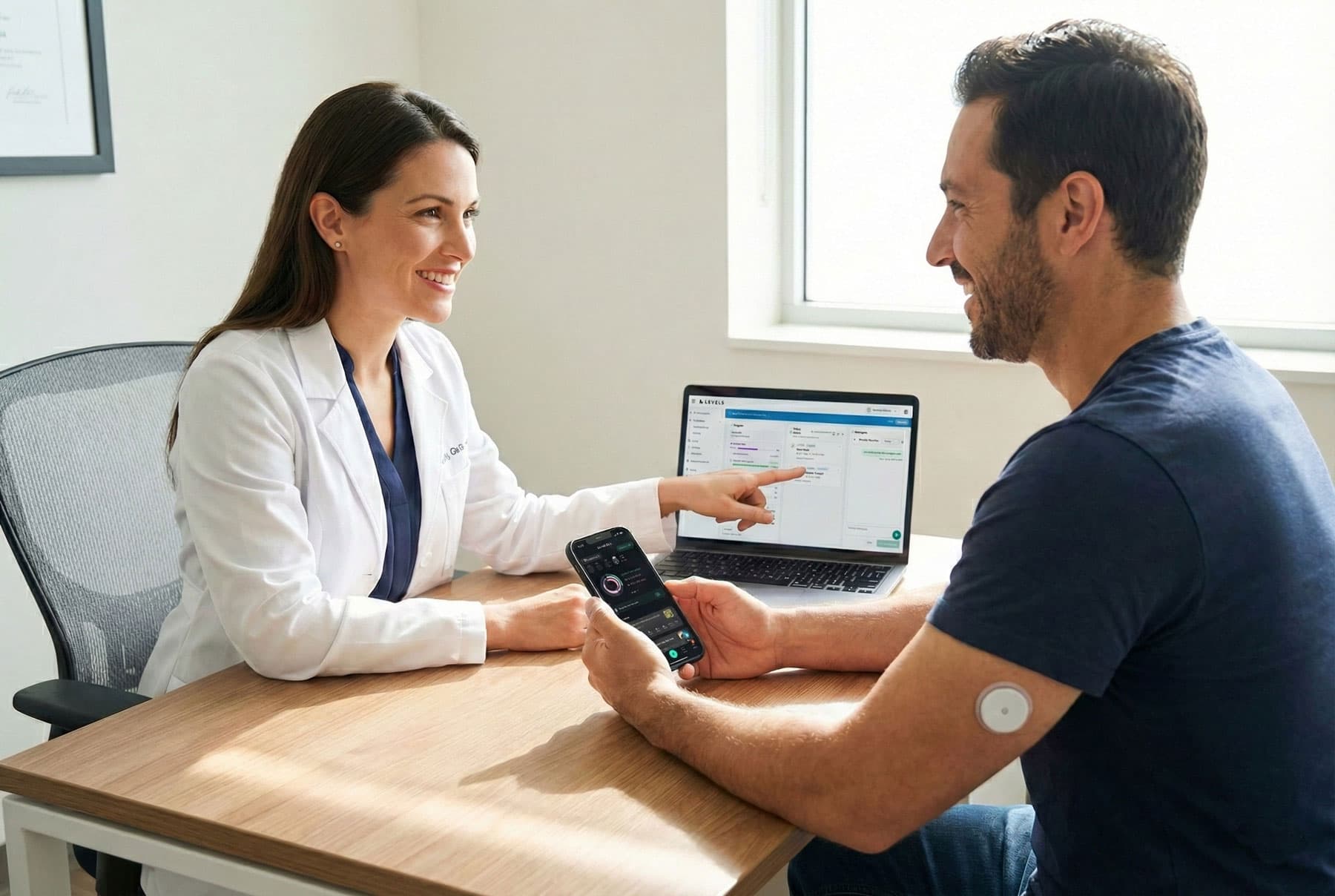
- View every logged meal on the same timeline as continuous glucose monitoring data, sleep, and activity.
- Review AI-generated meal summaries: "Patient logged 89% of meals. High-protein breakfasts correlated with stable glucose. Evening carb-heavy snacks drove spikes."
- Spot patterns in minutes instead of reconstructing cause and effect from separate systems.
Because food logs and CGM data are integrated in one app and one dashboard, clinicians spend sessions refining strategy, not decoding data.
What this enables: precision metabolic coaching
When food logs and continuous glucose monitoring live in the same system:
- Faster insight: Identify meal-glucose patterns in 5 minutes that would take 30 minutes with disconnected tools.
- Personalized recommendations: Move from generic diet advice to specific, testable experiments based on the patient's actual glucose responses.
- Better patient engagement: When patients see meals linked to real-time glucose data, they understand why changes matter and stay motivated.
- Scalable care: Manage food logging and CGM review across 50+ patients without manual cross-referencing or data entry.
From glucose traces to metabolic insight
Continuous glucose monitoring captures what is happening to blood sugar. Food logs explain why. When both are captured in the same patient app and displayed together in a practitioner dashboard, metabolic health coaching becomes precise, personalized, and scalable.
Levels is built to integrate food logging and CGM from the start: one app for patients to log and learn in real time, one dashboard (Levels Pro) for clinicians to review and guide with full context, and a unified system that turns food logs into the missing link in CGM-based care.