
Levels data shows real weight loss among members
A recent analysis shows that 7 in 10 overweight or obese members lose weight with Levels

Bottom Line Up Front: Levels data shows that 70% of members who are overweight or obese lose weight using continuous glucose monitoring and Levels. Obese members lose an average of 6 pounds (3% of body weight) in 90 days and many achieve 50-100 pound transformations—all without restrictive dieting or calorie counting.
The Missing Link Between Weight and Metabolic Health
Weight management connects to metabolic health through a complex web of hormonal processes that traditional diets often fail to address. At the center of this relationship lies insulin, your body’s primary fat-storage hormone, which responds directly to blood glucose levels throughout the day.
When you eat foods that spike your blood sugar—whether a seemingly healthy sweet potato or an obvious culprit like candy—your pancreas releases insulin to shuttle glucose into cells. But here’s the crucial fact: elevated insulin levels signal your body to store energy as fat rather than burn stored fat for fuel. This hormonal cascade makes sustainable weight loss nearly impossible if you’re constantly spiking blood sugar, regardless of how many calories you restrict.
The Data: Real Results from Real People
Two Complementary Analyses
Levels has conducted multiple analyses of member weight loss data, providing different but complementary perspectives on the program’s effectiveness:
2023 Analysis: Broader Population Study: This larger observational study analyzed BMI changes among members with elevated starting BMI. The analysis found that participants with elevated BMI experienced average BMI reductions of 0.7 points (overweight) to 1.04 points (obese). Since each BMI point represents 5-12 pounds, depending on body composition, this translates to an estimated 10+ pounds of weight loss for the average member with elevated BMI. Notably, 70% of members with elevated BMI achieved weight loss, with some experiencing dramatic transformations of 50-120 pounds.
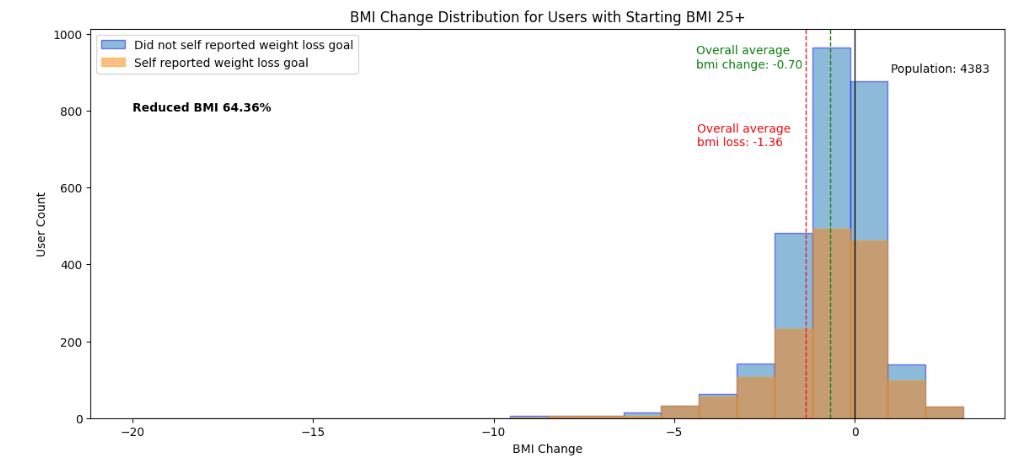
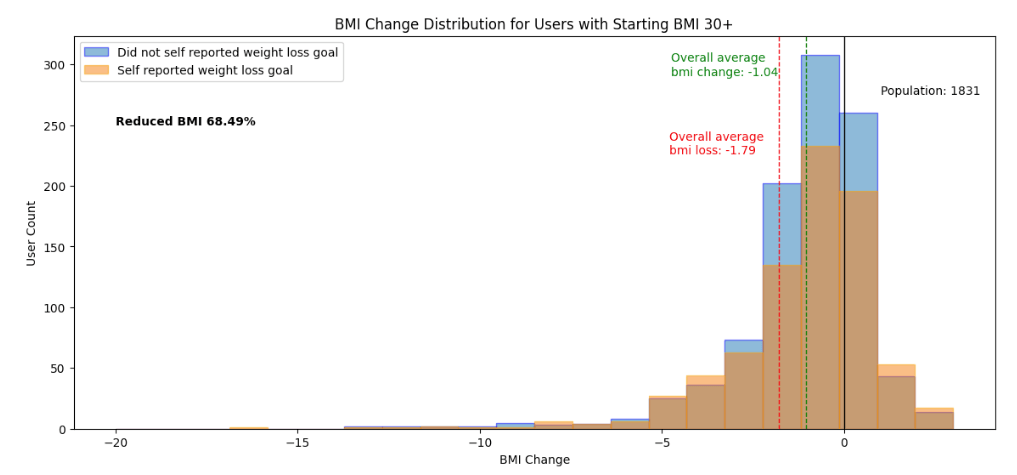
2024 Analysis: Controlled 90-Day Study: A more recent analysis tracked 238 members who recorded weight data during both baseline and 90-day periods:
- Healthy weight group (n=63): 0 pounds average change
- Overweight group (n=72): 2 pounds average loss
- Obese group (n=54): 6 pounds average loss (3% of starting body weight)
This controlled study provides a clearer picture of short-term weight changes, showing statistically significant weight loss in overweight and obese populations while healthy-weight members maintained their weight appropriately.
The Power of Engagement
Two critical patterns emerged from the data analysis:
Food Logging Correlation: Members who consistently log their meals in the Levels app experience significantly greater BMI reduction. The relationship is clear—the more frequently someone tracks their food and learns from their glucose responses, the more weight they lose.
Duration Matters: Weight loss success also correlates strongly with how long someone used a CGM. Members who wear their CGM longer achieve greater weight reduction, suggesting that sustained metabolic awareness drives lasting behavioral change.
Why CGM and Levels Drive Weight Loss
Real-Time Metabolic Feedback
Unlike traditional food journals that rely on delayed self-reporting, continuous glucose monitoring provides immediate, objective feedback about how your body responds to every meal. This real-time data creates what researchers call “the behavior change solution”—removing the guesswork and avoidance that plague conventional diet tracking.
Research published in Nutrients in 2024 examined the effects of personalized nutrition therapy coupled with CGM in 30 participants with prediabetes who were overweight or obese. When participants used CGM alongside personalized nutrition guidance, they lost nearly double the weight compared to a control group that received the same nutrition guidance without glucose monitoring. The CGM group also significantly reduced their carbohydrate intake—a change driven by seeing their individual responses rather than following generic dietary rules.
Breaking Through Individual Variation
One of the most profound insights from Levels data is how dramatically individual responses vary to the same foods. Take Betsy McLaughlin, who lost 81 pounds using Levels. Despite eating what she considered a healthy diet for 20 years—avoiding fast food, sodas, and processed sugar—her first CGM reading was shocking.
“My first meal was a boiled sweet potato, and my glucose shot up to 180 or 190,” McLaughlin recalls. “Then I had some quinoa, and the same thing happened.” Within a month of eating only the 30 foods that didn’t spike her blood sugar, she lost 15 pounds without changing her exercise routine.
More recently, member Debbie Monson shared how she lost 55 pounds with Levels solely by focusing on stable blood sugar. “The interesting thing is that I never looked at calories while I’ve been on this program at all,” she says. “The weight loss happened naturally.”
This personalization proves why generic diets often fail: foods considered universally “healthy” can be metabolically problematic for specific people. CGM reveals these hidden responses, allowing people to build truly personalized nutrition approaches.
The Accountability Factor
Beyond physiological insights, CGM creates unprecedented dietary accountability. As Brandon McDaniel, who lost 20 pounds with Levels, explains: “Nothing has made me more accountable to my diet than the CGM. Wearing a CGM is like having someone standing over your shoulder saying, ‘Are you really going to eat that?’”
This constant awareness drives meaningful behavior changes. Research shows that 87% of CGM users modify their food choices based on glucose feedback, and nearly half increase their physical activity levels.
The Science Behind the Success
Insulin’s Central Role
Insulin is your body’s primary anabolic hormone, promoting fat storage while inhibiting fat burning. When blood sugar remains elevated—whether from refined carbohydrates, poorly timed meals, or individual food sensitivities—insulin levels stay high, effectively locking your body in fat-storage mode.
Using CGM to identify and minimize blood sugar spikes, Levels members naturally optimize their insulin patterns. In fact, another recent analysis showed that 79% of Levels members who started with very high insulin (18.4 μU/mL) saw improvements, with an average drop of 11.9 μU/mL. This metabolic shift allows the body to access stored fat for energy, facilitating sustainable weight loss without the metabolic slowdown associated with calorie restriction.
Protein’s Multiple Benefits
Levels data consistently shows that members who increase protein intake achieve better weight management outcomes. Protein works through several mechanisms:
- Thermic Effect: Protein requires more energy to digest than carbohydrates or fats, naturally increasing calorie burn
- Satiety Hormones: Protein consumption increases leptin production, signaling fullness to the brain and reducing overall food intake
- Glucose Stability: Protein helps moderate blood sugar responses when consumed with carbohydrates
- Muscle Preservation: Adequate protein intake prevents muscle loss during weight loss, maintaining metabolic rate
Beyond Diet: Lifestyle Factors
CGM reveals how non-dietary factors significantly impact both glucose control and weight management:
Sleep Quality: Poor sleep drives next-day overeating and alters glucose responses to food and stress. Members often discover that inadequate rest dramatically impacts their metabolic flexibility.
Stress Management: Real-time glucose monitoring shows how psychological stress can spike blood sugar into prediabetic ranges, even during meals that typically produce stable responses.
Physical Activity: Even light movement, like post-meal walks, immediately improves glucose clearance, while sedentary periods can maintain elevated blood sugar for hours.
Practical Weight Management with Levels
Five Key Best Practices
- Use your CGM data to identify your personal “safe foods” Create a list of 20-30 foods that keep your glucose stable and build meals around these options, just like Betsy McLaughlin did when she lost 15 pounds in her first month.
- Prioritize protein at every meal Target 0.9g per pound of body weight daily, distributed as 20-30g per meal to maximize satiety, preserve muscle, and stabilize blood sugar responses.
- Eat protein and fats before carbohydrates This simple meal sequencing strategy can significantly blunt glucose spikes and improve your metabolic response to any carbs you choose to include.
- Log consistently in the Levels app Data shows a strong correlation between logging frequency and weight loss success—the more you track and learn from your glucose responses, the better your results.
- Focus on glucose targets, not just weight Aim for fasting glucose of 72-85 mg/dL and post-meal peaks under 110 mg/dL to optimize your body’s fat-burning potential while supporting overall metabolic health.
Conclusion
Given the underlying physiology, we’re excited but not surprised to see how many members have lost weight with Levels—notably without starving themselves. CGM empowers members to take a sustainable, personalized approach to reaching and maintaining their healthy weight by providing real-time feedback about how their unique body responds to different foods and lifestyle factors.

Manage your weight the healthy way with Levels
The best way to manage your weight is with real data and personalized guidance. That's what Levels Members get by using the app and a glucose biosensor to learn what foods and habits work for them. Click here to learn more about Levels.